English
 Dutch
Dutch Japanese
 Hindi
Hindi Italian
 Spanish
 French
 German
 Chinese
 Korean
 Arabic
 Hebrew
 Russian
 Portuguese
 Danish
 Czech
Czech Polish
 Swedish
5 Days
Easy
 Share
Share Updated: 18 May, 2026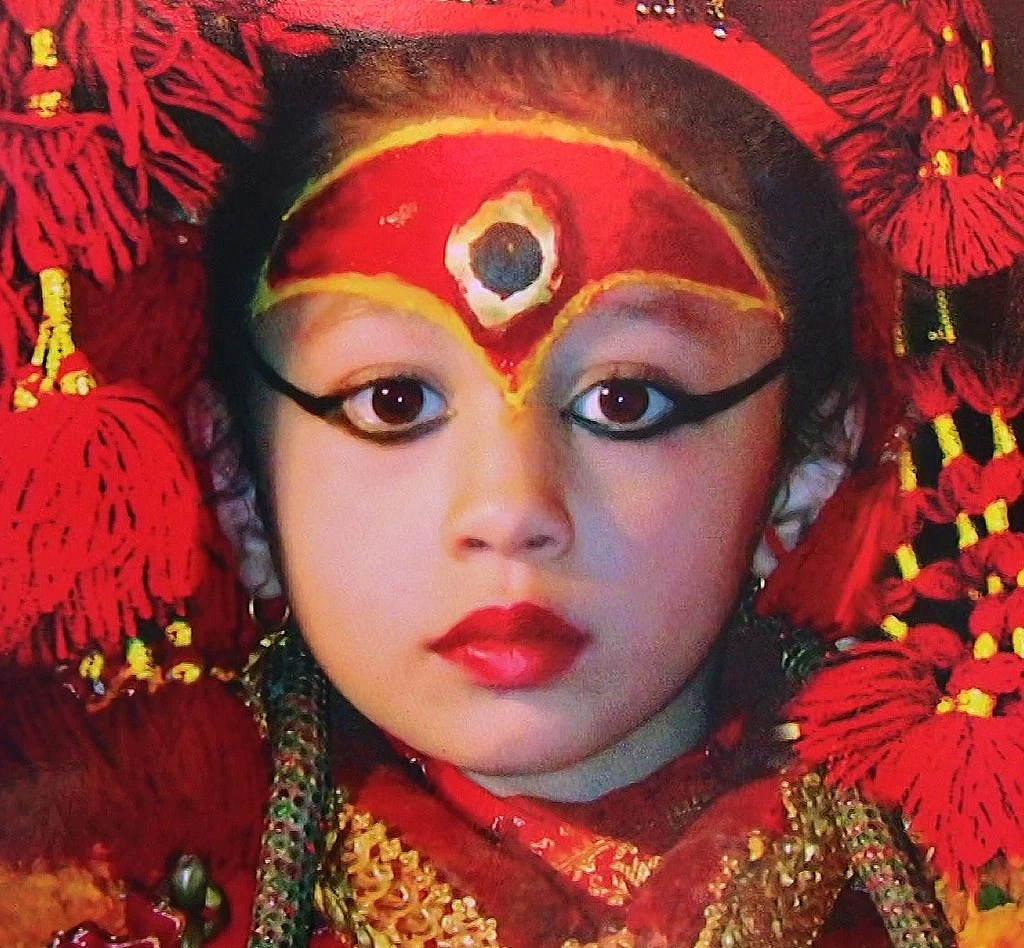
A prepubescent girl from the Shakya clan is selected to be the Royal Kumari of Kathmandu. She resides at Kumari Ghar, appears for daily darshan and returns to regular life after puberty.
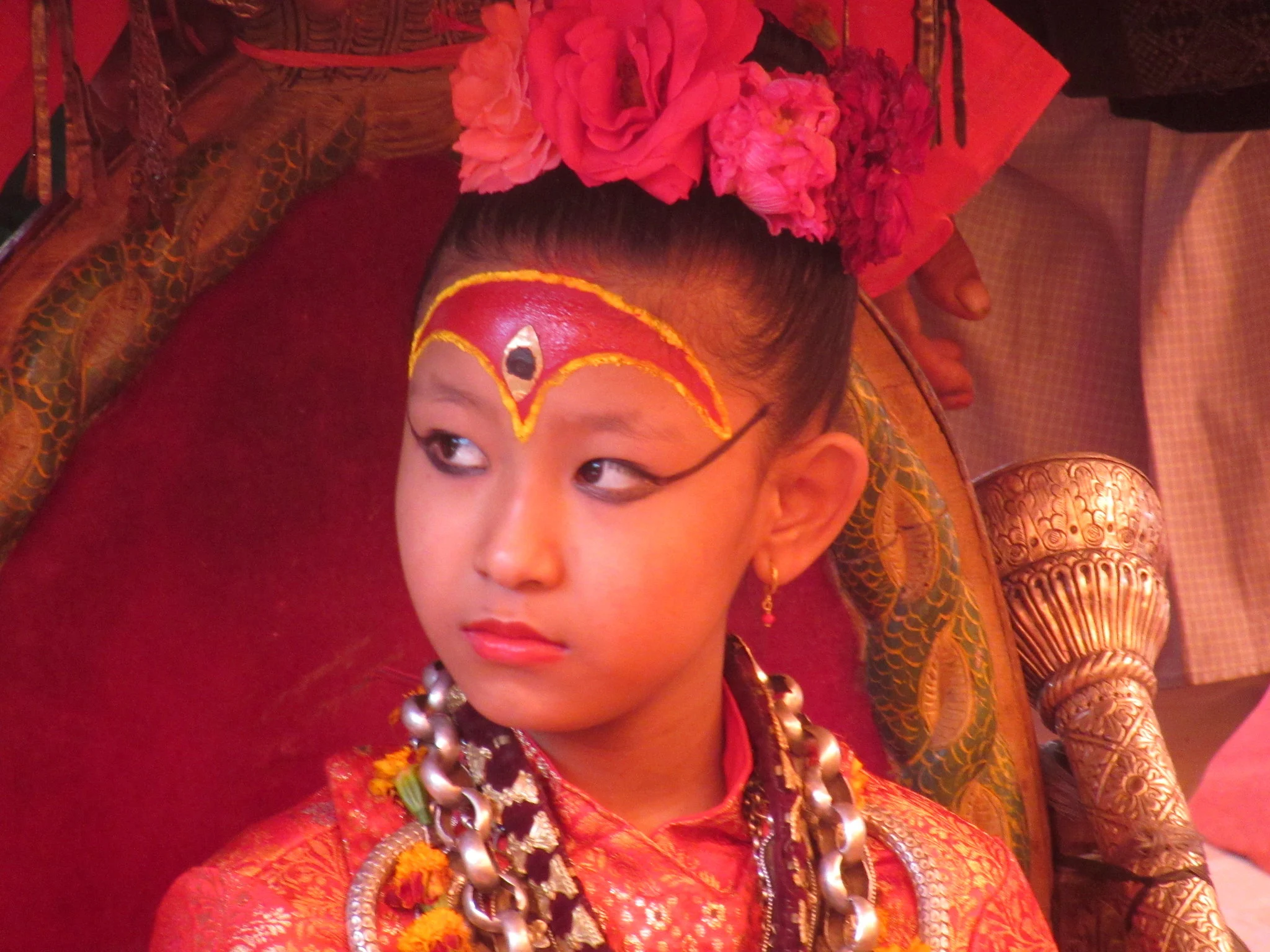
In the heart of Kathmandu’s Basantapur Durbar Square, a prepubescent girl is worshipped as a living goddess. She is the Kumari, a Newa child believed to be the physical embodiment of Taleju Bhawani (a fierce form of Durga and Kali) and, to Newa Buddhists, the wisdom deity Vajrayogini.
The tradition of the Kumari is a practice that is nearly a millennium old. The word Kumari comes from Sanskrit, meaning “virgin” or “princess.”
Unlike an idol or statue (which is a symbolic representation of a deity), the Kumari is considered a Dhyana Swarupa, a living embodiment of divine energy. She is not viewed as a human representing a goddess, but as the goddess herself in bodily form.
The term is distinct from Devi (a general Hindu goddess) or other female deities. While Devi refers to a divine feminine power in a cosmic or mythological sense, the Kumari is a specific, living instance of that power on earth.
Beyond religious importance, the Kumari tradition is a symbol of national and communal identity for Newas and the broader Nepalese population (Maharjan, 2024).
| Information | Detail |
| Location of Kumari House | Kumari Ghar, Basantapur, Kathmandu (inside Kathmandu Durbar Square). Click here for Map Direction: |
| Entry fee to see Kumari | Entry fee applies to Durbar Square (not separately for Kumari Ghar) |
| Best time to see Kumari | Twice a day. Approximately 11 AM and 4 PM (varies by season) |
| Days | Daily, except when she is ill or during certain rituals and festivals |
| Best month to visit Kumari | September (Indra Jatra festival, where she rides the chariot) |
| Nearby Attractions | Kathmandu Durbar Square (UNESCO), Taleju Temple (adjacent but not open to non-Hindus), Hanuman Dhoka Palace Museum, Indra Chok market, Asan market |
The goddess who manifests in the Kumari is primarily Taleju Bhawani, a form of Durga and Kali revered by the Malla kings. Taleju is a Tantric goddess of royal power, and her relationship to the Kumari is one of direct possession or indwelling.
When a girl becomes Kumari, Taleju’s spirit is understood to leave her celestial abode and reside in the girl’s body. Taleju is considered a royal and protective manifestation of the same cosmic feminine power (Shakti) that appears as Kali in her fierce form and Durga as the slayer of demons.
The sacred title used to address her in the Newa language is Dyo-mayju, meaning “a woman with godliness” (Maharjan, 2024).
In Newa Buddhism, the Kumari also embodies Vajrayogini or Vajravarahi, a Tantric Buddhist deity. Thus, the same child is worshipped by Hindus as Taleju and by Buddhists as Vajrayogini, reflecting Nepal’s unique religious synthesis.
As an embodiment of Durga, the Kumari is believed to possess the combined power (tapas) of all the gods to protect the state (Lidke, 2015).
5 Days
Easy
While the Royal Kumari of Kathmandu (based at Kumari Ghar in Basantapur Durbar Square) is the most famous, she is not the only one. Several other Kumaris exist across the Kathmandu Valley, each serving a specific locality or palace.
In addition to these, there are other minor Kumaris across the valley, serving local guardian deities or specific Newa communities. Unlike the Royal Kumari, some of them are not required to live in isolation and their selection criteria may be less elaborate.
Each Kumari functions independently, with her own palace, attendants and festival schedule. The term “Kumari” therefore refers to a category of living goddesses, not a single individual.
| Kumari Name | Years as Kumari |
| Kumari Hira Maiya Shakya | 1922–1923 |
| Kumari Chini Shova Shakya | 1923–1931 |
| Kumari Chandra Devi Shakya | 1931–1933 |
| Kumari Dil Kumari Shakya | 1933–1942 |
| Kumari Nani Shova Shakya | 1942–1949 |
| Kumari Kayo Mayju Shakya | 1949–1955 |
| Kumari Harsha Lakshmi Shakya | 1955–1961 |
| Kumari Nani Mayju Shakya | 1961–1969 |
| Kumari Sunina Shakya | 1969–1978 |
| Kumari Anita Shakya | 1978–1984 |
| Kumari Rashmila Shakya | 1984–1991 |
| Kumari Amita Shakya | 1991–2001 |
| Kumari Preeti Shakya | 2001–2008 |
| Kumari Matina Shakya | 2008–2017 |
| Kumari Trishna Shakya | 2017–2025 |
| Kumari Aryatara Shakya | 2025–present |
The most widely cited legend involves King Jayaprakash Malla, the last Malla king of Kathmandu. According to this version, the king played dice nightly with the goddess Taleju in his palace.
One night, he made a lewd remark or attempted to touch her. The goddess, enraged, disappeared. She later appeared to him in a dream, saying she would only return if he worshipped a virgin girl from the Shakya or Bajracharya clan as her living embodiment.
Another version focuses on the king playing dice with Taleju. When questioned by his queen about his mysterious nightly companion, the king followed the queen’s suggestion to leave an object behind to identify the visitor. Taleju, angered by this breach of trust, vanished but agreed to manifest as a child goddess.
1 Day Days
Easy
Buddhist origin attributes the tradition to Vajra Deva, a medieval Newa Buddhist master, who established the worship of a child goddess as a Vajrayogini manifestation.
The Kumari Jatra (chariot festival) is said to have originated from this Buddhist lineage.
A mother dreaming of a red serpent during pregnancy is interpreted as a divine sign that the girl may be chosen as the next Royal Kumari (Paudel, 2022).
The serpent (naga) has symbolic importance in both Hindu and Buddhist Tantric traditions. Red is the color associated with the goddess Taleju (whom the Kumari embodies), as well as with creative energy, life force (Shakti) and power.
Pre-Malla period references to child goddess worship exist but are not fully verified. The tradition is believed to have originated during the Malla reign in the 13th century (Maharjan, 2024). The Malla dynasty set the standard for the selection criteria, rituals and the 32 physical perfections.
The Shah dynasty, starting with Prithvi Narayan Shah (1768), continued the tradition, though the Kumari’s formal relationship shifted from the king as Vishnu-incarnate to a symbolic guardian of the state.
A new Kumari is selected when the current Kumari:
The girl must be from the Newa Shakya (goldsmith) or Bajracharya (priestly) caste. Her astrological birth chart (Kundali) must meet specific requirements.
The girl must possess all 32 perfect physical characteristics, including:
She must have no scars, missing teeth, blemishes or visible imperfections.
Her horoscope must align with the king’s horoscope (historically) and show absence of planetary afflictions.
The most psychologically intense test. The girl spends a night alone in a dark room with 108 severed buffalo heads, surrounded by blood and masked dancers. She must remain still, silent, and unafraid. This tests whether she remains calm when Taleju is expected to appear. Any sign of fear or crying disqualifies her.
After selection, the girl is formally married to the deity (or historically, to the king as Vishnu’s incarnation). This symbolic marriage means she cannot marry as a mortal. Her loss of mortal marital prospects is accepted as part of her divine status.
The selection process is finalised when the girl accepts a nut offered by the Royal Priest (Poddar, 2005).
Typical selection age is 2-4 years old. The process usually occurs in auspicious months, most commonly before the Indra Jatra festival in September.
Kumari’s day begins before sunrise. She undergoes ritual bathing using holy water (cold water is never used).
Her dressing has a fixed sequence: red clothes, specific jewellery, and the Bhogini headdress. Her hair is styled into three distinctive buns. She wears the Agnichur, a snake-shaped third eye painted on her forehead.
Her toes and lower feet are painted with a special holy red colour called ‘ala:’ (Maharjan, 2024).
The Kumari has to abide by numerous restrictions:
She lives a sequestered life with very few selected playmates and is only allowed outside the palace a few times a year for specific festivals (Gurubacharya, 2025).
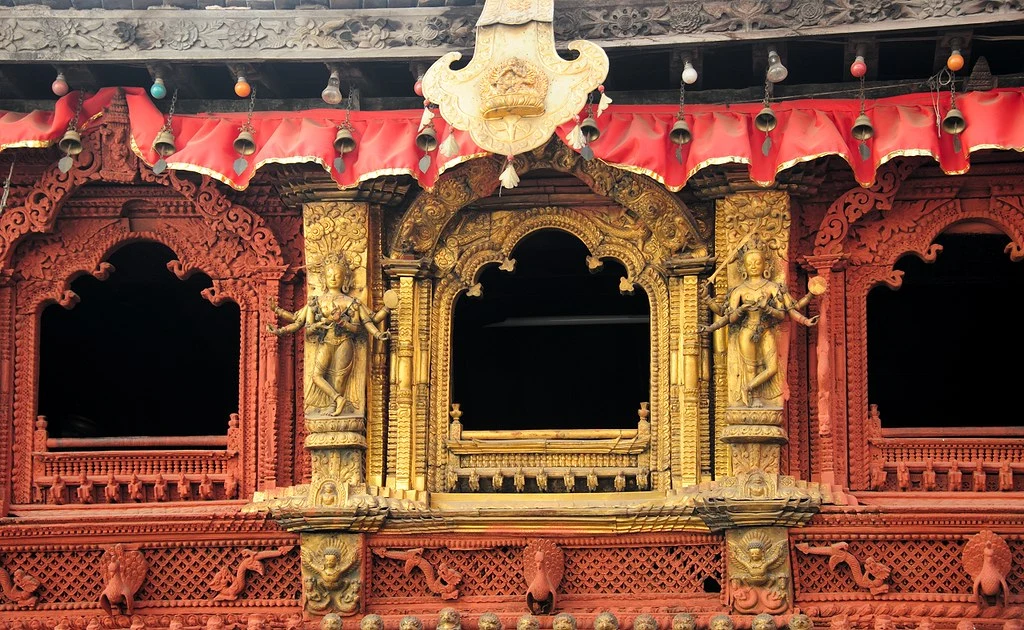
Kumari’s palace is located inside Basantapur Durbar Square, Kathmandu. Its layout includes an inner courtyard, carved windows and the Taleju temple adjacent.
Other rooms include the throne room, living quarters and prayer room. The famous three-tiered balcony is where she appears for public darshan.
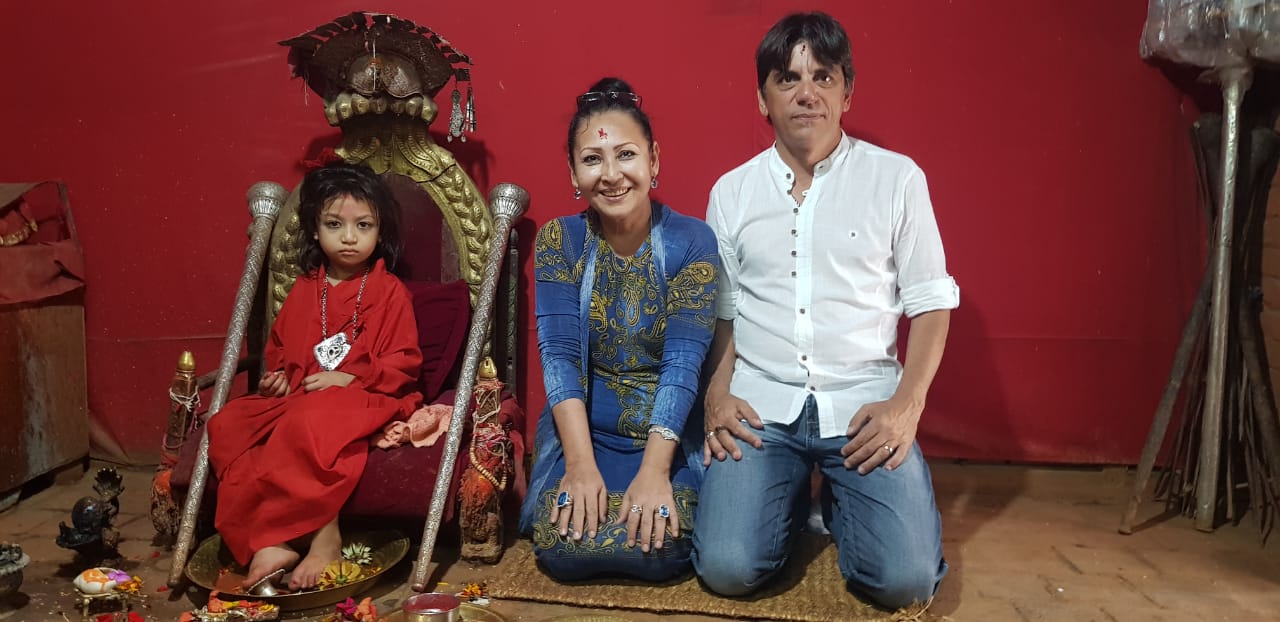
She sits on a throne with a copper plate beneath her feet (Maharjan, 2024).
The Chitaidar (caretaker or nurse) manages daily care. The Guruju (chief priest) handles rituals. Other support staff assist with household needs. The Kumari’s mother often lives with her inside the palace.
The Kumari appears at the window typically around 4 PM (seasonal variations occur). She usually stares expressionlessly and sometimes waves.
For viewers, crying or screaming from the Kumari is interpreted as a bad omen. Her appearance at the window is usually pretty short.
Indra Jatra (September) is the most important festival for the goddess.
The Kumari rides a chariot in procession through Kathmandu.
In earlier times, the king would receive divine vision (darshan) during this festival. Now-a-days, she gives blessings to high-ranking officials, including the President of Nepal (Gurubacharya, 2025). She puts tika (vermilion powder) on the foreheads of her devotees, everyone from ordinary citizens to the president and prime minister (Maharjan, 2024).
The Bhairava mask performance is also done during the rituals. Mohani (Dashain) involves special rituals and offerings. Kumari Puja marks her own birthday celebration with specific ceremonies, usually done during Asthami or Navami of Navaratri (October/November).
Her mood swings or health, especially if witnessed by are sometimes viewed as premonitions for the nation (Maharjan, 2024).
A Kumari stops being one when she gets her first menstruation. Serious illness or blood draw also triggers retirement. Usually, a Kumari retires between 10-14 years of age.
A twelve-day confinement called Gufa marks the start of her life transition to returning to a regular life. Gufa is a traditional coming-of-age ritual for Newa girls in Nepal. However, for a former Kumari (the Living Goddess), it specifically marks the end of her divine status and her transition back to a normal mortal life.
During this period, Taleju’s power returns to the goddess (meaning the deity withdraws from the child’s body). The girl is stripped of royal titles and jewelry. She then leaves the palace forever.
The Nepalese government provides retired Kumaris with a small monthly pension (approximately $110) to assist with their transition (Gurubacharya, 2025).
Adjusting to normal life is difficult for many ex-Kumaris. A Kumari can’t go to a regular school during her tenure which can make it difficult to integrate into school life with kids her age when she retires.
However, as former Kumari Chanira Bajracharya revealed in an interview with the Kathmandu Post, Kumaris have a private tutor to help them catch up with their academic work (Pokharel, 2024).
Social stigma might also affect her marriage prospects later in life. According to Nepalese folklore, men who marry a former Kumari are destined to die young, which often results in these women remaining unmarried (Gurubacharya, 2025). However, nearly every former Kumari of marriageable age eventually marries (Tree, 2015).
Despite the end of the monarchy, the Kumari remains a vital symbol of Nepalese cultural identity (Lidke, 2015).
Recent reforms, including a Supreme Court mandate for formal education and government pensions for ex-Kumaris, show what is being done to adapt this tradition to modern times (Poddar, 2005; Gurubacharya, 2025).

Rajan Lamichhane, the Founder and Managing Director of Namaste Nepal Trekking & Research Hub, brings over 17 years of expertise in the tourism industry. With a profound passion for trekking and mountaineering, he has led numerous trekking and cultural tours across Nepal, Tibet, and Bhutan, prioritizing safety, enjoyment, and sustainability. Under his leadership, Namaste Nepal Trekking has become a trusted name in adventure travel industry.