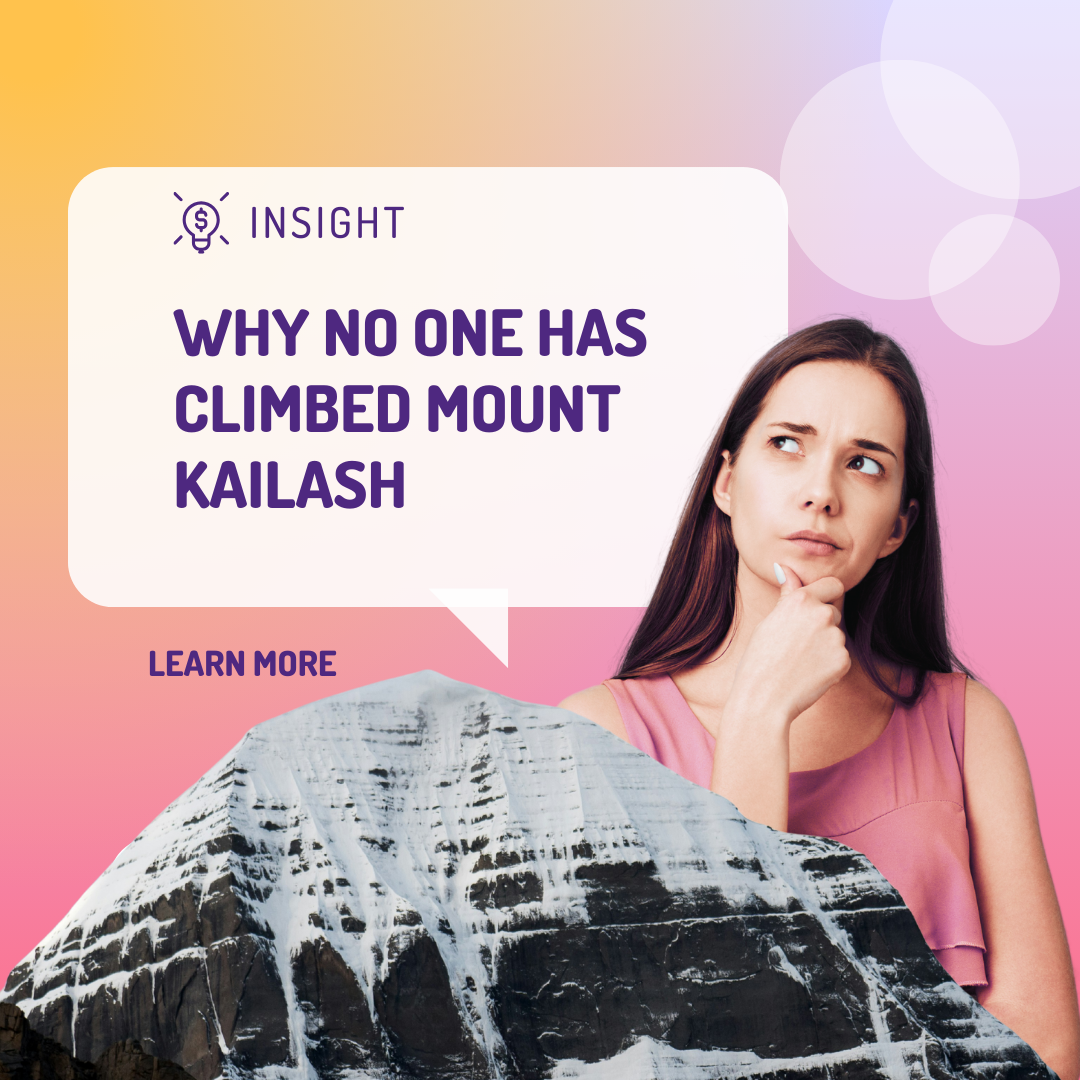
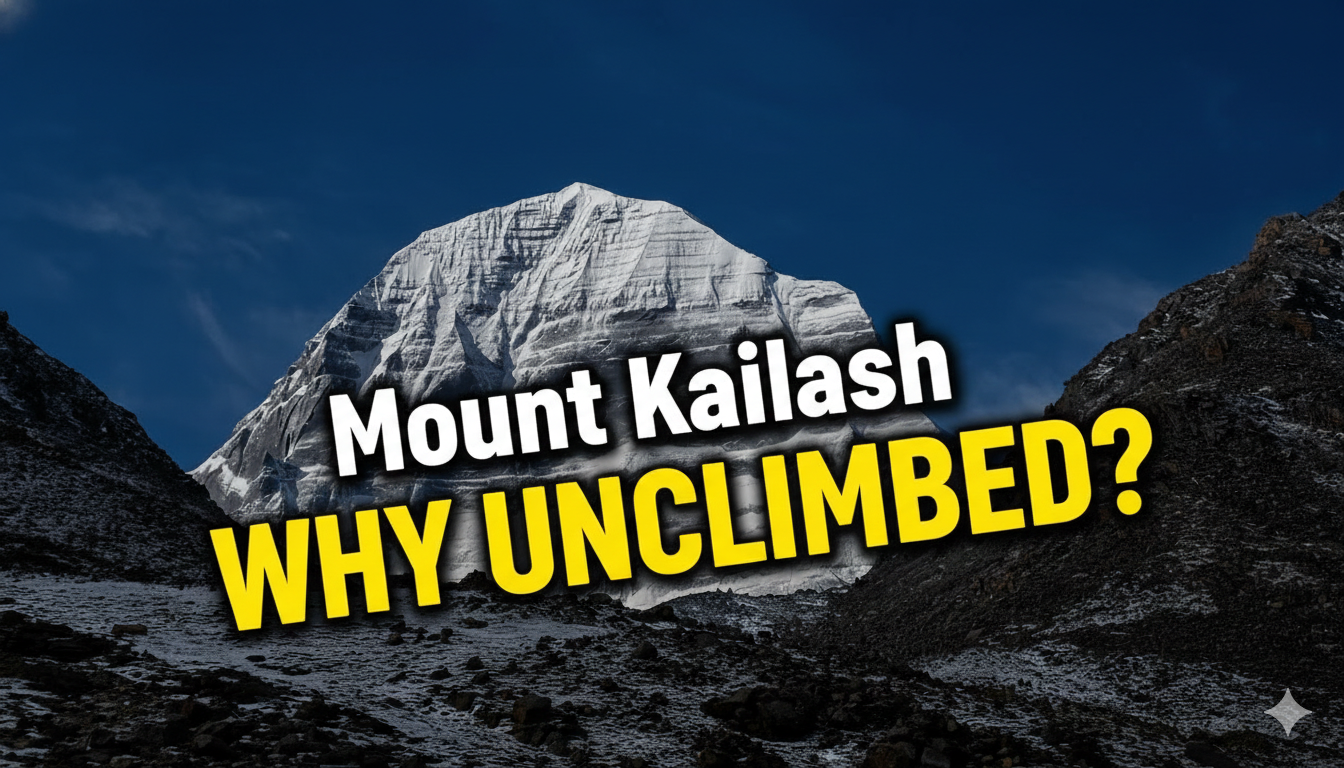
Mount Kailash is a unique mountain in terms of shape, faith, location, beauty, and natural energy. It stands tall and majestic in the distant Tibetan Himalayas. Mount Kailash, which has an altitude of just 6,638 m. It’s not the highest mountain in the world, and it’s not the hardest to climb from a technical point of view. But it is still one of the biggest mysteries on Earth: no one has ever climbed Mt. Kailash.
So far, practically all of the world’s highest summits have been climbed, yet Mt. Kailash is still standing as a symbol of the unclimbed, the holy, and the really sacred.
Mt Kailash is surrounded by two famous lakes, Lake Manasarovar (freshwater) and Lake Rakshastal (saltwater). The glaciers of Mount Kailash are also the source of four major rivers of Asia: the Indus, Brahmaputra, Sutlej, and Karnali. Because of its unique geography, deep spiritual significance, ancient legends, modern government rules, and the harsh natural conditions, Mount Kailash remains untouched/unclimbed till now.
Those who wish to see Mount Kailash up close can take the Kailash Kora (circumambulation), but they cannot go beyond certain areas near the mountain. So, today in this blog, you will understand in detail why no one has climbed Mt. Kailash.
Recommended Trip
Kailash Mansarovar Yatra From Nepal | Registration Open 2026
Before we talk about the causes, let’s learn a little bit about Mount Kailash.
Location: It is located in one of the most remote and vast regions of the Himalayas, in Tibet, an autonomous region of China. It’s part of the Gangdise Shan mountain range, a segment of the Trans-Himalaya.
Height: Mount Kailash stands at 6,638 meters (21,778 feet), while Mount Everest, the world’s tallest mountain, is 8,848 meters (29,032 feet) tall. Even though Kailash has a respectable height, there are many taller mountains, so height is not a reason that it has an unclimbed status.
Appearance: Kailash has four faces, and its shape is like a pyramid-like peak. It has a perfectly symmetrical shape, so people often think that it is engineered or that some alien lives here. The top of the peak is always covered with snow. Its slopes are rugged and dramatic.
Source of Great Rivers: The Indus, Brahmaputra, Sutlej, and Karnali (a major tributary of the Ganges) all flow from this area. Many religions call Kailash the “Axis Mundi” or “Center of the World” because it is an important spiritual and geographical center.
The Spiritual Hub: Out of many religions, Kailash is a spiritual place for Hinduism, Buddhism, Jainism, and the native Bon faith of Tibet. They see this palace as a holy spot. It’s not only a mountain for them, but they see this place as a holy place, a living god, and a source of energy.
Now, let’s see the multiple reasons why this Kailash remains unclimbed by humans.
Why No One Has Climbed Mount Kailash?
Reason 1: The Profound Spiritual Significance – A Sacred Abode, Not a Challenge
This is, without a doubt, the greatest and most important reason why no one has ever attempted Mount Kailash. Kailash is not a physical obstacle for the hundreds of millions of people who love it; it is a heavenly presence that should be loved and respected from a distance. Climbing Kailash would not be a victory, but it would create a serious act of disrespect, sacrilege, and spiritual contamination.
Let’s look at how each of the four primary religions sees Mount Kailash:
Hinduism: The Dwelling of Lord Shiva
Lord Shiva
Hindus believe that Mount Kailash is the permanent home of Lord Shiva, who is one of the most significant gods in the Hindu religion. Shiva is the ultimate ascetic, god of gods, the yogi of yogis, and the one who destroys ignorance and illusion. According to the Hindus, Shiva sits here with his family, and it is a place for meditation. He controls the entire universe from here.
Why no climbing? To climb Mount Kailash would be to disturb Lord Shiva’s eternal meditation. It would defile the purity of his sacred home and invite grave karmic consequences. Hindus believe that only those who are completely pure in thought, word, and deed could even think about approaching its summit, and even then, their intention would be worship, not conquest. It’s believed that anyone who dares to ascend the peak would meet a tragic end, suffer great misfortune, or face eternal spiritual damnation. The mountain is seen as a living, breathing god, not merely a natural formation.
Buddhism: The Home of Chakrasamvara
Tibetan Buddhists call Mount Kailash Mount Meru and believe that it is the home of the Buddha Demchok, also known as Chakrasamvara. Demchok is an angry god who stands for ultimate happiness and enlightenment. There is also a famous legend that Milarepa, a famous Tibetan yogi, tantric, and poet, meditated and had a spiritual fight with Naro Bön-chung, a Bon shaman, here. Milarepa is said to have won the contest by flying to the top of Mount Kailash at sunrise, which made the mountain even more important in Buddhist stories.
Why no climbing? Buddhists believe that climbing the mountain would disrupt the spiritual energies and sacred purity of the site, preventing spiritual progress for countless others. It would show a lack of wisdom and compassion. The true path to enlightenment, according to Buddhist teachings, is inner spiritual work, not the physical conquering of a sacred space. The pilgrimage around the mountain (the Kora) is the sacred journey, not the ascent.
Jainism: The Site of Rishabhanatha’s Enlightenment
Jains call Mount Kailash Astapada. For them, it is a place where Rishabhanatha, the first Tirthankara (spiritual teacher) of Jainism, found freedom (moksha) and nirvana. People think he gave up all his worldly ties and meditated on the mountain till he reached spiritual perfection.
Why no climbing? Jains think that Mount Kailash stands for the highest level of spiritual peace. People think that climbing it would be disrespectful to Rishabhanatha’s enlightenment. Jainism says that you should be very respectful to all living things and holy sites. The Kailash represents purity and letting go of worldly aspirations; therefore, trying to “conquer” it by climbing goes against its genuine spiritual meaning.
Bon Religion: The Soul of Tibet
Mount Kailash, also known as Mount Tise or Gankhar Tise, is the holiest location for the indigenous Bon religion of Tibet, which came before Buddhism in the area. It is thought to be the center of all spiritual force and the heart of the Bon kingdom, where elemental spirits and gods come together.
Why no climbing? For Bon devotees, hiking Mount Kailash would be a terribly insulting thing to do to their spiritual history and the land itself. It would upset powerful spirits and bring bad luck to the area. The Bon pilgrimage custom is different from other faiths since it requires walking around the mountain in a counter-clockwise route.
To put it simply, the spiritual motivations are quite powerful. All of these religions agree on one thing: Mount Kailash is a holy site that is alive, not a mountain to climb. The fact that it hasn’t been climbed shows how much faith and respect millions of people have for it.
Reason 2: Governmental Protection and Conservation Policies
Here are some of the practical reasons why climbing Kailash is forever restricted or forbidden to climbers all over the world. The Chinese government, which administers the Tibetan Autonomous Region, has officially banned all climbing on Mount Kailash. Here is the reason why:
Respect for Religious Beliefs: The Chinese government doesn’t want to hurt the sentiments and faith of a number of people of different religions. Not allowing climbing Kailash shows how the Chinese are respectful to other religions as well. It also helps to avoid international controversy and keeps the mountain protected as a sacred place.
Environmental Protection: The Himalayan high altitude ecosystem is extremely fragile. So opening climbing will lead to waste, pollution, and damage to the peaceful environment. This region is also the source of major rivers, so keeping adventure tourism away helps protect the water, wildlife, and the overall balance of nature.
Cultural Preservation: For centuries, Kailash whole area has kept its cultural value and holds a legacy. This culture may be damaged if climbing and tourism aren’t controlled. Spiritual places will turn into just climbing destinations, so it is necessary to ban them to maintain their importance.
Logistical Challenges and Safety: There is no proper human settlement near Mt. Kailash due to its remote location. So modern infrastructure is lacking here. Climbing here would be risky, and rescue operations would be extremely costly and difficult. The government likely wants to avoid such scenarios.
Reinhold Messner’s Influence: In the early 2000s, there were reports of the Chinese authorities considering allowing a Spanish team to attempt a climb. However, legendary mountaineer Reinhold Messner, who was offered the chance to be part of an expedition but refused, famously spoke out against the idea. He stated, “If we conquer this mountain, then we conquer something in people’s souls… I would never go there.” His influential stance, along with global protests from religious groups, led the Chinese government to officially enforce the ban, declaring that Mount Kailash is for pilgrimage, not for climbing. This decision effectively shut down any future climbing possibilities.
So, the main cause of it is that it is impossible to climb Mt. Kailash due to spiritual beliefs. Climbing Kailash is not possible today due to the Chinese government’s official ban on all climbing activities in the area.
Reason 3: The Extreme Physical and Environmental Challenges
Although it is not the main cause, we should not ignore the physical and environmental difficulties of Mount Kailash. Even if the spiritual and government bans were removed, climbing Kailash would still be very hard and dangerous due to these reasons:
Extreme Altitude: Kailash is in the “death zone” at over 21,700 feet, where the air is very thin and deadly. Climbers would be at a very high risk of getting altitude sickness (AMS, HAPE, HACE), hypothermia, and frostbite. Getting used to the new environment would take a long time and be difficult to do.
Remote Location: Kailash is actually quite lonely. It takes days to go to the nearest big town, and getting to the base of the mountain is a difficult task. This means that supplies, medical help, and rescue services won’t be easy to get to.
Harsh Weather Conditions: The weather on the Tibetan plateau is very bad. Temperatures drop well below freezing, heavy snow falls often, and strong winds can blow for days. Weather windows for climbing would be short and hard to forecast.
Technical Difficulty (Likely): There is no official climbing route or proper inspection, but many who have seen the slopes say they are exceedingly steep, maybe unstable, and likely to have rockfalls or avalanches. The pyramid shape of the mountain suggests steep cliffs and rough terrain that would need high climbing skills and gear.
Lack of Infrastructure: There are no fixed ropes, established camps, or expert porters who are used to helping climbing groups. In a very dangerous place, climbers must have to be able to take care of themselves completely.
Reason 4: Legends, Myths, and the Aura of Mystery
Apart from the practical reasons, there is also a hidden force that protects Mount Kailash since there are lots of mysteries, legends, and stories that show that this is not an ordinary mountain.
The Unseen Protectors: Local Tibetan people believe that divine beings guard this mountain. They often tell stories that in ancient times, those who tried to climb it lost or never returned. Enlightened masters, or powerful spirits, prevent anyone from reaching their summit with impure intentions.
Time Distortion: There is a popular belief that time moves differently around the Mt. Kailash. Those who have completed the Kora around Mt. Kailash say that their hair and nails grow significantly faster than usual here in just a period of time.
The Axis Mundi/Cosmic Center: Ancient texts and traditions describe Kailash as the “axis mundi,” the cosmic axis or world pillar that connects heaven and Earth. It’s believed to be the spiritual center of the universe, a place where cosmic energies converge. This belief imbues the mountain with a sacred power that makes human conquest seem insignificant and inappropriate.
Mysterious Lakes: At the base of Mount Kailash, there are two different types of lakes: Lake Manasarovar and Lake Rakshastal.
Lake Manasarovar is a freshwater lake, considered holy, symbolizing light, purity, and life. Pilgrims bathe in its icy waters to cleanse themselves of sins.
Lake Rakshastal is a saltwater lake, considered demonic, symbolizing darkness and evil. It’s shaped like a crescent moon, and its waters are never used for drinking or bathing. The stark contrast between these two lakes, lying side-by-side, adds to the mystical allure of the region and is often interpreted as representing the dualities of life – good and evil, light and dark.
Ancient Civilizations and UFOs: Some fringe theories, often linked to ancient astronaut theories, suggest that Kailash is either a man-made pyramid built by an advanced ancient civilization or a landing site for extraterrestrial beings, due to its unusual shape and perceived energy. While not mainstream, these theories add to the mountain’s mysterious appeal.
Even though climbing Mt. Kailash is forbidden but for those who want to experience its spiritual power, they can go for a Kailash Mansarovar Yatra, also known as Parikrama or Circumambulation. It’s a pilgrimage walk around the base of Mt. Kailash, which is done by thousands of pilgrims/devotees each year. Everyone can join this pilgrimage from all around the globe.
The Purpose: It is believed that doing this spiritual walk around the Kailash cleanses the sins and brings good Karma and leads to spiritual liberation. It’s a journey of devotion, endurance, and self-discovery. It takes three days to complete the Kailash Kora, which is around 52 kilometers (32 miles) long. You need to cross the challenging mountain pass, Dolma La Pass at 5,630 meters/18,471 feet.
The Experience: The weather is harsh at high altitude, but even in such conditions, with the help of basic food and accommodation facilities, it is manageable. It is a spiritual journey, not a luxury tour. It demands a good fitness level from the travellers.
The True Conquest: After reaching here, people will understand their inner self, not a mountain. People learn to let go of ego, desires, and worldly attachments.
The existence and significance of the Kora highlight that it’s more than a journey to a sacred site. It is a heavenly palace that every traveller must visit once in their lifetime.
The Future of Mount Kailash: Remaining Unclimbable
Even though we cannot predict the future, we are sure that Mount Kailash will remain forever unclimbed. Also, it’s our own responsibility to protect the sacred site and the beauty of nature that has been given to us. The mountain’s high religious respect, strict government laws, and natural barriers all work together to make it impossible to get through.
Growing Global Awareness: We should inform people that we should not encourage people to climb. It’s a victory to remain unclimbed.
Spiritual Preservation: Due to modernization, there are very few places left on Earth that remain unconquered. To respect and show the symbol of faith, we should preserve this spiritual destination.
A Symbol of Respect: Keeping Mount Kailash unclimbed shows respect for the beliefs of millions of people and honors its sacred nature.
Conclusion: The Unconquered Summit of Faith
We hope you have found all the answers as to why Mount Kailash remains unclimbable to this day. Kailash is truly a beautiful peak, and if you ever wish to see it with your own eyes, we recommend joining the Kailash Mansarovar Kora. At Namaste Nepal, we organize Kailash trips and have successfully helped visitors fulfill their dream of standing at the foot of Mount Kailash. If you want to know more related to trips, cost, and any queries you have, then we suggest you contact our tour operator. Thanks for reading. Om Namo Shivaya!!!!!!!!
Sabin Shrestha is an experienced content writer with over 4 years of expertise in creating clear and engaging content. He specializes in writing about lifestyle, travel, health, and technology, delivering well-researched articles that connect with readers. Known for his storytelling skills and attention to detail, Sabin creates content that informs, inspires, and leaves a lasting impression on audiences.


 English
 Dutch
Dutch Japanese
 Hindi
Hindi Italian
 Spanish
 French
 German
 Chinese
 Korean
 Arabic
 Hebrew
 Russian
 Portuguese
 Danish
 Czech
Czech Polish
 Swedish
 Share
Share Updated: 30 November, 2025