Nepal has lifted the ban on 26 major social media platforms that were previously blocked over registration failures. Platforms like Facebook, X, Instagram, and YouTube are now accessible again in the country.
Since today, Nepal has officially banned 26 social media platforms after a 7-day ultimatum to be registered. This dramatic shift has sent ripples throughout the nation and the entire tech world.
Social media such as Facebook, Instagram, YouTube, and X (formerly Twitter) are now totally blocked in Nepal. The ban is the first of its kind, depriving millions of users of daily areas of digital space.
The government expressed that these sites did not meet the registration requirement as required during the specified period. Regulations, according to authorities, are needed to establish accountability, security, and appropriate digital governance.
Such an audacious move is a turning point in the digitization of Nepal. It poses significant questions concerning free expression, business effects, and the reaction of international tech giants to local legislation.
Clients can now connect with Namaste Nepal easily through Email Viber for updates, inquiries, and support. FOLLOWING ARE THE BEST WAY TO CONNECT WITH US:
The Ministry of Communication and Information Technology, on September 4, 2025, declared that 26 social media websites will be officially blocked in Nepal. The prohibition was enforced right after the ultimatum had elapsed in 7 days. In its official release, the ministry clarified that the platforms had not enrolled themselves under the new Nepalese digital regulations, and that the regulation is needed to make the platforms accountable, secure, and protect users.
The Scope:
The list of platforms has been comprehensive, totaling 26 sites in total, and it is obvious that this is not a targeted or focused move, but a blanket digital takedown. Facebook, X (previously Twitter), Instagram, and YouTube are some of the largest players in the world, and they are the core of the ban, which blocks out millions of daily users. On top of these giants, the limitation also affects numerous platforms within the social networking, video sharing, messaging, and content creation services that are redefining the ways Nepalis connect and communicate over the internet.
The Mechanism: How is the ban being enforced?
Yes, on September 4, 2025, the Nepal government officially wrote to the Nepal Telecommunications Authority (NTA) requesting that all the internet service providers (ISPs) block the unregistered social media sites.
The order is based on the resolution of the Ministry of Communication and Information Technology to implement the Directives on the Management of the Use of Social Networks, 2023. In so doing, the government will seek to regulate and subject these platforms to regulatory compliance with its mandatory registration policy.
The “Why”: Unpacking the Registration Failure
The Government’s Stance:
The Nepal government has clarified that the social media platform that is going to be operated in the country has to be registered formally by the Directives of the Managing the Use of Social Networks, 2023. The conditions are the establishment of a local office or representative in Nepal, one designated contact person, tax compliance, acceptance of content moderation obligations, and national standards of data privacy and security.
According to the officials, such steps are aimed at promoting accountability, national security, data protection, and efficient taxation of international technological corporations that are operating in Nepal. The government says that in the absence of such regulation, platforms are free to operate outside the bounds of local law, which makes it hard to restrict harmful content, protect user data, or earn fair revenue on digital products.
Why Did Platforms Fail to Comply?
Various reasons could have contributed to the non-compliance with social media in Nepal. To begin with, the specifications were complicated and bureaucratic, requiring local offices, predetermined contacts, content moderation systems, and firm data protocols.
Some companies might have found the economic feasibility of establishing local operations in Nepal expensive due to the cost and logistics of doing so. Another conflict is that of national and global operating models, as most tech giants are accustomed to working with similar policies internationally without adjusting to national laws.
The fear of creating a world precedent may have left the companies reluctant, as other countries might have similar strict rules. Certainly, these platforms might have misjudged the determination of the Nepali government or have been inadequately engaged and negotiating a viable resolution when the 7-day deadline lapsed.
Immediate Impact and Fallout
For Nepali Citizens/Users:
Communication Breakdown: Millions of Nepali people will now be unable to access their social media for chatting, networking, and staying in touch.
Information Access: Social media plays a big role in providing information; banning this will affect news consumption, public discourse, and limit access to diverse perspectives online.
Search for Alternatives: Some people will turn VPN, which will create a security risk and make it harder for authorities to monitor safe internet use.
Psychological Impact: ASudden ban can bring frustration, disorientation, and a sudden sense of being cut off from the digital world.
For Businesses and Economy:
Marketing & Advertising: Most of the businesses nowadays rely on social media for promotion, sales, and customer engagement. So now, being cut off from this social media can result in severe disruption.
E-commerce & SMEs: Those small and medium-sized enterprises (SMEs) have already built a status on these social platforms. Banning will put their operation and online presence at risk.
Content Creators & Influencers: Many content creators will lose their audience, impacting income and visibility.
Tourism Industry: In the 21st century, social media has played a great role in promoting travel destinations and travel services. The ban on major platforms makes it harder for tourism businesses to reach international visitors.
Overall Economic Downturn: The ban may discourage foreign investment in Nepal’s digital sector and slow growth in online businesses.
For the Government:
Public Reaction: The ban has sparked backlash, online and offline protests, and divided opinion among Nepali citizens.
International Scrutiny: Human rights organizations and international bodies might raise concerns about restrictions on freedom of speech and access to information.
Challenges in PR: The government faces difficulty managing the narrative and justifying the ban both domestically and globally.
Broader Implications and The Road Ahead
Digital Sovereignty vs. Global Internet:
Similar to countries like the USA, Saudi Arabia, and the United Arab Emirates, which control the internet, Nepal also now follows this trend. This movement has raised questions and debate among people who own the internet, global tech companies, or individual countries that enforce laws and regulations.
Future of Digital Economy in Nepal:
The ban on this social media can help to grow the local platforms, but it also risks stifling innovation by restricting access to global tools and networks. Additionally, it may affect foreign tech investment and slow the growth of digital literacy, as users and businesses lose exposure to international platforms and technologies.
Freedom of Speech & Press Concerns:
The ban has raised serious worries about censorship and the restriction of online spaces for public debate. Many fear it could limit avenues for dissent and constrain independent reporting, affecting both journalists and everyday users seeking to share information freely.
Potential Resolutions & Scenarios:
After the ban, the social media platform may comply and make compromises, and work under Nepal’s regulatory guidelines. The Communication Minister stated that the ban will be lifted immediately once a company complies and registers with the government.
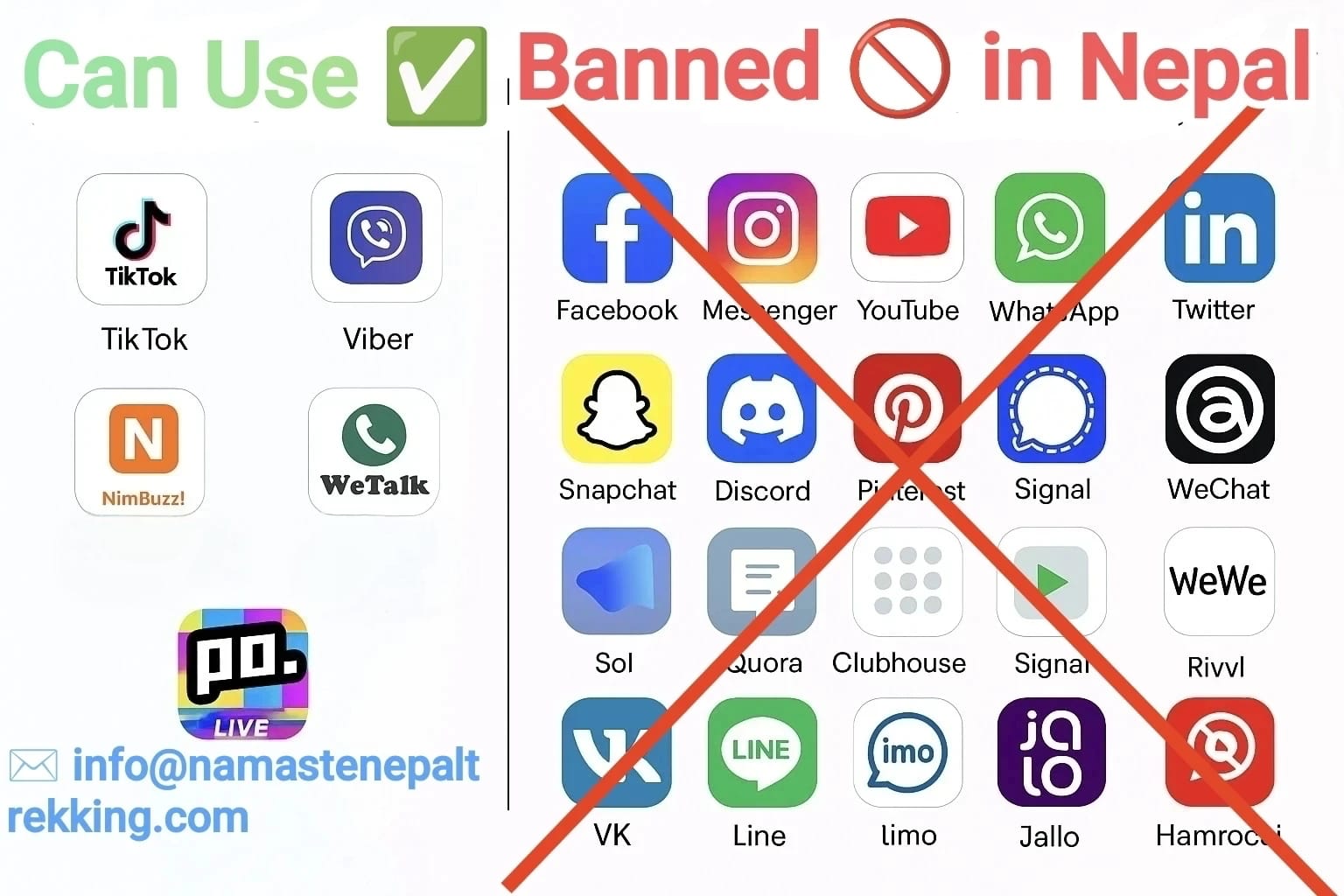
Nepal social media ban list
Facebook
Facebook Messenger
Instagram
YouTube
WhatsApp
X
LinkedIn
Snapchat
Reddit
Discord
Pinterest
Signal
Threads
WeChat
Quora
Tumblr
Clubhouse
Mastodon
Rumble
VK
Line
IMO
Zalo
Soul
MeWe
Hamro Patro.
What You Can Do Now: Use Registered Platforms
Even though major platforms like Facebook, YouTube, WhatsApp, Messenger, andX remain blocked, you can still connect with registered social media platforms such as Viber, TikTok, Numbuzz, WeTalk, and PopoLive. It will help you connect with friends, family, and stay online for communication and business purposes.
Scan us and add in Viber: Namaste Nepal Trekking & Research Hub in Viber.
Conclusion: A New Digital Dawn or Dusk for Nepal?
After the final decision from the Nepal government to ban the unregistered social media platform, it can create disrupted communication, business, and access to information. If all these unregistered app is banned, then we suggest you choose the registered platform. We hope that the unregistered platform will come for registration under the Nepal government law, and the scenario will become normal like before. Keep in touch with us for the latest news about the ban of major social media in Nepal.
Sabin Shrestha is an experienced content writer with over 4 years of expertise in creating clear and engaging content. He specializes in writing about lifestyle, travel, health, and technology, delivering well-researched articles that connect with readers. Known for his storytelling skills and attention to detail, Sabin creates content that informs, inspires, and leaves a lasting impression on audiences.


 English
 Dutch
Dutch Japanese
 Hindi
Hindi Italian
 Spanish
 French
 German
 Chinese
 Korean
 Arabic
 Hebrew
 Russian
 Portuguese
 Danish
 Czech
Czech Polish
 Swedish