English
 Dutch
Dutch Japanese
 Hindi
Hindi Italian
 Spanish
 French
 German
 Chinese
 Korean
 Arabic
 Hebrew
 Russian
 Portuguese
 Danish
 Czech
Czech Polish
 Swedish
16 Days
Moderate
 Share
Share Updated: 6 November, 2025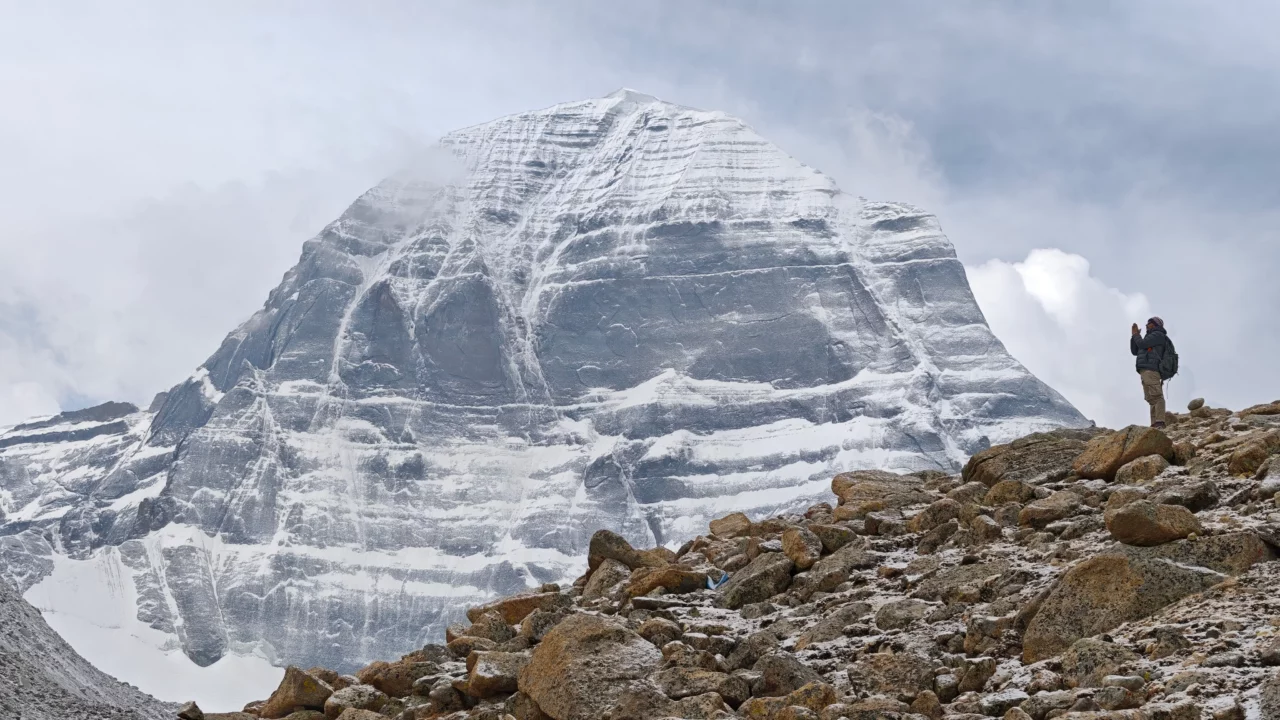
| Attribute | Details |
| Mt Kailash Altitude | 6,638 m (21,778 ft) |
| Mt Kailash Local Tibetan Name | Kangrinboqê or Gang Rinpoche |
| Mt Kailash Sanskrit Name | Kailāsa (कैलास) |
| Mt Kailash in Nepali | Kailash Parbat (कैलाश पर्बत) |
| Mt Kailash Location | Tibet Autonomous Region of China |
| Coordinates | 31.0675° N latitude and 81.3119° E longitude |
The world is filled with renowned mountains; however, none are as special as Mount Kailash. It is neither a mountain for mountain climbers, nor for thrill-seekers. But, it is a pilgrimage fort and a spiritual seeker mountain. The peak standing on the Tibetan Plateau is 6,638 meters high, and with its unusually shaped pyramidal peak, it is one of the most mysterious and sacred spots on the planet.
Mount Kailash is located close to Lake Mansarovar and the origin of four major rivers, such as the Indus, the Sutlej, the Brahmaputra, and the Karnali river, and has been revered for thousands of years. It is located in remote western Tibet, which adds its spiritual appeal.
Mount Kailash has not been special simply because it is so beautiful, but also because it is sacred to many religions. Hinduism considers it to be the abode of Lord Shiva and his mate Parvati. It is a cosmic mandala and the way of enlightenment in Buddhism. It is the location at which the first Tirthankara, Rishabhdev, obtained liberation in Jainism. The spiritual focus of the world is perceived in the Bon religion.
The Kailash Mansarovar is a holy journey, and thousands of believers participate in the journey every year. This holy circuit is a trek around the mountain known as the Kailash Parikrama or Kora, which is supposed to purify sins and is a source of spiritual prosperity. As opposed to Mount Everest or other mountains in the Himalayas, no one has ever attempted to climb Mount Kailash because it is strictly considered holy and untouchable.
Mount Kailash is not only a mountain but a holy place of divine power to travelers, seekers, or pilgrims. This is a once-in-a-lifetime journey that is made complete by the Kailash trek, holy dip in Lake Mansarovar, and beautiful Himalayan landscape on the Chinese side, namely Tibet.
This introduction demonstrates why Mount Kailash is so special and why others across the world travel to feel its spiritual attraction. 16 Days ModerateRecommended Trip  Kailash Mansarovar Yatra From Nepal | Registration Open 2026
Not only is Mount Kailash a holy place, but it is a geographically amazing land. The mountain stands high in the Trans-Himalaya in Western Tibet and stands at 6,638 meters (21,778 feet) above sea level. Being a sovereign state of Western Tibet in the remote Ngari Prefecture, it is one of the areas of the Himalayas that are barely touched and hardly even learned about.
The pyramid-like shape of the mountain seems to be too perfect to occur naturally. It looks like a man-made building as it has four nearly symmetrical sides topped with snow and ice. This aesthetic shape has caught the attention of many explorers and scientists, but to the faithful, this structure is a perfect creation of God.
The other phenomenal fact is that nobody has ever climbed Mount Kailash. In contrast to Mount Everest or other mountains in the Himalaya, no expedition has ever climbed to the top. Not only religious beliefs but also the traditions of the Tibetan people prohibit climbing the sacred mountain. This pristine condition contributes to its mystique and augments the spiritual reverence it attracts all over the globe.
Beyond its stunning beauty, Mount Kailash is also called the “Source of Life”. From its glaciers and valleys emerge four of Asia’s greatest rivers:
These rivers provide life to millions of people across Asia, making Mount Kailash not just a sacred mountain but also a geographical heart of the continent.
For pilgrims and travelers, standing before this majestic mountain truly feels like being in a place where Earth touches Heaven—a land where natural beauty, mystery, and spirituality come together in perfect harmony.
The Ban on Climbing Mount Kailash: Unlike other peaks that are popular in the Himalayas, Mount Kailash has never been climbed. This is primarily because it is a sacred religious sphere. Hindus, Buddhists, Jains, and Bon followers believe that the mountain is too sacred to be touched. It lies at the highest point, which is believed to be the throne of Lord Shiva and a spiritual attraction point of the world. Out of reverence, the Chinese government, in addition to international mountaineering organizations, has prohibited any climbing activities.
Besides the religious prohibitions, the mountain is a physical impossibility, too. It is sheer in nature, fickle weather, and has ice-covered hills, making it very dangerous. Even in the situation of permission, it would have been one of the most challenging mountaineering activities in the world.
Read the fascinating story of Milarepa and his sacred cave — the legendary yogi believed to be the only person who ever climbed Mount Kailash. Here is the link: Milarepa Cave in Tibet
Famous Climbers Who Refused: Over the years, some of the best climbers in the world have expressed interest in Mt Kailash, but none have taken up the challenge. The legendary Italian climber Reinhold Messner, famous for his climbs on Mount Everest and other 8,000-meter peaks, once visited the area. However, after learning about the deep spiritual importance of Mount Kailash, he openly refused to climb it. Many other mountaineers have expressed the same view, respecting the belief that this mountain should remain untouched.
The Spiritual Argument for Its Inaccessibility: This is not a weakness of Mount Kailash, but its most powerful asset: It is still virgin. To believers, its inaccessibility is used as a symbol of the impossibility of humankind to conquer the divine by their ambitions. Whereas the triumphant ascents hail mountains such as Everest, Kailash is hailed by its inaccessibility.
To the pilgrims who do the Kailash Kora, as part of the Kailash Mansarovar Yatra, the virgin peak adds extra meaning to their journey. It makes them remember that there are certain lands which should be conquered but respected and worshiped.
Claims of Kailash as a Man-Made Pyramid: Other scientists and adventurers have wondered whether Mount Kailash could not be natural at all. They say that its dome-like nature of being the perfect pyramid and symmetrical sides, reminds them of a giant man-made pyramid. Based on these explanations, the mountain could have been a significant element of an old complex that existed to serve spiritual or ceremonial purposes. Although it is viewed by mainstream science as a natural peak, the strange shape remains a source of astonishment and argument.
Connection to Ancient Civilizations or Extraterrestrials: There have been assumptions about ancient civilizations and even aliens due to the pyramid theory. According to some of the theorists, these people of the ancient may have possessed a higher architectural vision needed to build something as precise as this. Some theorists propose, furthermore that the mountain could have been a waymark of more advanced beings outside of Earth. Such claims, though not scientifically valid, contribute an attractive precision concerning the enigma of Mount Kailash, and it is a favorite subject of conspiracy theorists and adventurers.
“Earth’s Axis” or “World Pillar” Theories: The second thought is that Mount Kailash is the Axis or the Pillar of the World. Texts in Hinduism, Buddhism, and Bon refer to Kailash as the center of the world, the connection between Heaven and Earth. Under this belief, its special energy and location make it a cosmic axis and so it links the physical world with spiritual worlds. When pilgrims complete the Kailash Parikrama or Mansarovar Yatra, they commonly experience a certain spiritual power during the walk.

Anecdotal Evidence of Accelerated Hair and Nail Growth: Unusual phenomena are reported by a number of pilgrims and other travelers who have visited Mount Kailash. There are reports that their hair and nails were growing more rapidly than usual, or they perceived themselves poorly during the time that they stayed there. Although this is only because these are anecdotal reports, this only adds to the mystery and unexplained source of energy in the mountain.
Theories Behind the Phenomenon: A number of theories have been postulated to explain such strange experiences:
Formal studies have yet to confirm none of these theories, but the descriptions of rapid aging and time distortion remain fascinating to explorers, scientists, and spiritual seekers alike.
Connection to Spiritual Energy or Inter-Dimensional Portals: These phenomena have been perceived as spiritual manifestations of great spiritual power at Mount Kailash by many spiritual traditions. There are theories that the mountain is a portal or inter-dimensional gateway between the realms of this world and the above worlds. Those who follow the Kailash Kora or participate in the Kailash Mansarovar Yatra tend to convey feelings of heightened consciousness, serenity, and feelings of greater closeness to God.

Mount Kailash as a Gateway to Shambhala: The Himalaya folklore dating back to ancient times says that the place is not merely a mountain but a portal to the land of myths, the Shambhala realm. Shambhala is another name used in Buddhist and Tibetan culture that was referred to as a veiled point of nirvana, also meaning enlightenment, peace, and high spiritual learning. It is thought that pilgrims to Mount Kailash are in close contact spiritually with this hidden realm.
Hidden Caves, Advanced Beings, and Ancient Texts: Tales around Mount Kailash indicate that there are secret caves that have sages and enlightened beings. There are tales of the caves holding some ancient texts and knowledge regarding the universe, lost civilizations, as well as religious activities. These myths have continued to capture the imaginations of explorers and pilgrims over the centuries, giving the mountain a mystique and godliness.
The Agartha Connection and Hollow Earth Theory: Certain theorists associate Mount Kailash with other mythical underground worlds, such as Agartha, referred to in both Eastern and Western mythologies. Within this conception, the mountain would be the entry point to an inner Earth civilization commonly referred to as the Hollow Earth theory. Although this can be regarded as speculative, it adds to the mystical status of Mount Kailash, the place of meeting of spiritual life energy, ancient wisdom, and concealed worlds.
Mount Kailash Scientific Research: What NASA Sees on Mt Kailash?
Reports of Strange Sounds: Many pilgrims and travelers visiting Mount Kailash report hearing unusual sounds in the remote valleys. Some describe chanting, humming, or a continuous buzzing “Om” sound, even when no one is nearby. These mysterious sounds have fascinated both spiritual seekers and explorers, adding to the mountain’s sacred and mystical reputation.
Unexplained Lights and Atmospheric Phenomena: Besides sounds, pilgrims have also reported weird lights either in the sky or on the mountain. Others experience auras of light or floating light or strange reflections in Lake Manasarovar and other snowfields in the area. The phenomena are usually observed in the morning, or evening, or at certain spiritual occasions that generate an out-of-this-world experience.
Scientific Explanations vs. Supernatural Interpretations: Scientists suggest that some of these phenomena may have natural explanations, such as:
Located near Mount Kailash are Lake Manasarovar and Lake Rakshastal, which appear in a very contrasting manner. A sacred freshwater lake Meditation known as Manasarovar, is symbolic of purity and spiritual blessings. In contrast, a saltwater lake, known as Rakshastal, is symbolic of darkness and struggle and connected with Ravana in Hindu mythology. There is an idea that the lakes could be interconnected under the ground, and secret depths are reservoirs of spiritual power. Such contrast can be defined as the eternal force of light and darkness, good and evil. 19 Days ModerateRecommended Trip  Kailash Manasarovar Yatra with Everest Base Camp and Lhasa

The world-renowned Lake Manasarovar (or Mapang Yongcuo in Tibetan) is located next to the Kailash mountain. It is a fresh lake at an elevation of 4,590 meters, which means it is one of the highest fresh lakes in the world. Hindus claim that Lake Manasarovar was formed by Lord Brahma, who is the representation of purity, wisdom, and light.
Pilgrims who take part in the Kailash Mansarovar Yatra often bathe in its holy waters, believing it will cleanse their sins and bring spiritual blessings. For Buddhists, it represents the lake of supreme bliss, while Jains consider it equally sacred. Surrounded by the snowcapped Himalayas of Tibet, Lake Manasarovar shines with unmatched beauty, making it a symbol of peace and divinity.

Besides the two big lakes, there is also a holy place called Gaurikund that pilgrims visit, which is also known as Thugje Chenpo Tso in Tibetan. This is a holy lake, located close to the Kailash Parikrama route. Hindu tradition states that it is where Goddess Parvati meditated very deeply to attain Lord Shiva. The lake is regarded as the symbol of kindness and devotion. Holy water is considered to be its water, as many pilgrims carry it because it is believed to bless them with purity and love of God.
Just above Manasarovar, at a guess, about fifteen miles away, is another curious lake, the Rakshastal, or Langtso, as it is called in Tibetan. The Rakshastal river is, however, a saltwater lake, unlike Manasarovar, which has aquatic life. In Hindu tales, it is believed to be the demonic lake and symbolizes negativity and the forces of anti-light. Mythology dictates that it was the house of Ravana, the demon king, meditated at this place in order to obtain power through Lord Shiva.
The difference between the two lakes is sharp: Lake Manasarovar (purification and light) and Lake Rakshastal (darkness and struggle). This contrast signifies the ever-present harmony of life: good and evil, light and darkness, innocence and desire.
The Mount Kailash region is not only famous for the sacred mountain and holy lakes but also for several other fascinating attractions that add depth to the Kailash Mansarovar Yatra experience.
Located about 70 km from Mount Kailash, Tirthapuri Hot Springs are an important pilgrimage site for both Hindus and Buddhists. It is believed that the springs were blessed by Padmasambhava (Guru Rinpoche) and are associated with Parvati and Shiva. Pilgrims take ritual baths here, believing the hot waters cleanse body and soul after completing the Kailash Kora.
Astapad means “eight steps” and is closely connected to Jainism. It is believed that this is the place where Rishabhadeva (Adinath), the first Tirthankara, attained moksha (liberation). Many pilgrims visit Astapad after completing the parikrama to pay homage to this sacred site.
On the path of the Kailash Parikrama, pilgrims pass through Yam Dwar, also called the “Gateway of the Lord of Death.” According to Hindu belief, this is the place where the body and soul separate, symbolizing leaving behind worldly attachments before starting the sacred walk around Mount Kailash.
The Tarboche Valley, also known as the Valley of the Gods, is famous for the giant prayer flagpole that is raised every year during the Saga Dawa Festival. Thousands of Tibetan Buddhists gather here to celebrate the birth, enlightenment, and death of Lord Buddha. This valley is filled with mani stones and prayer flags, making it a deeply spiritual spot.
Along the Kailash Kora, two important monasteries stand as resting points for pilgrims:
Close to Lake Manasarovar is Langak Tso, another scenic lake. Nearby stands the ancient Chiu Monastery, perched on a hilltop with panoramic views of Lake Manasarovar. It is believed that Guru Rinpoche meditated here, adding to its religious value.
Nandi Parvat is a sacred mountain located near Mount Kailash in Tibet. In Hindu mythology, it is believed to be the abode of Nandi, the divine bull and loyal vehicle of Lord Shiva. Pilgrims see it as a symbol of devotion, strength, and protection during the holy Kailash Mansarovar Yatra.
The beauty of Mount Kailash is that it has religious significance to more than a single faith. To billions of Hindus, Buddhists, Jains, and Bon followers, it is a spiritual focal point of the world.
To Hindus, Mount Kailash is the resting place of Lord Shiva and his wife Parvati. It is mentioned in the Puranas as the stellar point, Mount Meru, which links Heaven and Earth. Devotees feel that doing the Kailash Parikrama (circumambulating the mountain) cleanses them of sins and provides liberation or moksha. This makes the Kailash Mansarovar yatra (pilgrimage) the holiest of all the pilgrimages in Hinduism.
In Tibetan Buddhism, the mountain is equally sacred as Mount Kailash. It is considered the abode of Chakrasamvara, a fierce deity responsible for representing supreme bliss.
It is also linked to Milarepa, the famous Tibetan saint, who is believed to have meditated and achieved enlightenment here. For Buddhists, circumambulating the mountain—known as the Kora—is an act of deep devotion and a path to spiritual awakening.
In Jainism, Mount Kailash is known as Ashtapada, the place where Rishabhadeva (Adinath), the first Tirthankara, attained nirvana or ultimate liberation. For Jains, this sacred mountain marks the highest point of spiritual victory and is a symbol of detachment, purity, and freedom from the cycle of rebirth.
The ancient Bon religion, which predates Buddhism in Tibet, also honors Mount Kailash as its most sacred site. Followers of Bon see it as the spiritual heartland of the universe, the center from which all life emerges. To them, walking around the mountain in a counter-clockwise direction fulfills ancient traditions and brings blessings.
Kailash Kora, Parikrama is a circumambulation of Mount Kailash, and a pilgrimage around the mountain, which attracts pilgrims of the world. The trek is both a physical expedition that traverses around the mountain and also a very spiritual experience. Pilgrims make the Kora in order to seek blessings, purification, and spiritual development with a view that their sins would be removed and they would achieve enlightenment through this process.
The trek winds through valleys high up in the mountains, sacred rivers, ancient pilgrimage sites, and monasteries, and tests the human body whilst cleansing the soul. Pilgrims collectively conduct ceremonies, recite prayers, and meditate to reach their physical and spiritual destination of the Mount Kailash Kora as a journey to test their strength and an act of spiritual transformation.
Pilgrims circumambulate Mount Kailash in order to attain a strong spiritual purpose. It is said that the pilgrimage cleans up its sins and builds up merit and assists pilgrims in their spiritual journey through life. Many people view the trek as a chance to look closer to the divine and get enlightenment. The Kailash Parikrama is not only a personal journey but also a spiritual milestone to many travelers because many people have this dream in their lives.
Mount Kailash Kora is a trek that requires a person to be physically fit since it is a high-altitude trek. Pilgrims are advised to do training and acclimatization prior to the trip. Proper hiking boots and layering, as well as trekking poles, can help them be safer and more comfortable during the trek.
Not only a physically demanding trek, but a mentally challenging one as well. The key is staying resilient, patient, and open. Pilgrims usually have to endure long miles of walking, adverse weather conditions, and other lacking facilities, and hence having a strong and calm mind will help them finish Kailash Parikrama successfully.
It is important to plan. Tourists do require permits and visas, usually facilitated by well-established tour operators. It is also necessary to budget for the Kailash Mansarovar Yatra as the costs involved in the yatra are travel and stay, and the use of guides and trekking equipment. Proper planning ensures a smoother and safer pilgrimage experience. Read more: Difficulty and Preparation of Kailash Kora
The main starting point of Kailash Kora is from Darchen. To reach Darchen, pilgrims can use different routes from Nepal, India, and China. Pilgrims can also hire a pony or a personal porter if they need help completing the Kailash Kora.
The trek officially begins as pilgrims move from Darchen to Dirapuk. Along the way, they catch their first breathtaking views of Mount Kailash’s North Face. This initial stretch helps overcome the early challenges of high-altitude trekking.
Day 2 is the most demanding leg of the Kailash Parikrama. Pilgrims cross the Drolma La Pass, the highest point of the Kora, facing extreme altitude and weather conditions. Along the way, they visit the Shiva Sthal, a sacred site with prayer flags and offerings, and stop at Gauri Kund (Lake of Compassion), a place of deep spiritual significance. This day tests physical endurance and mental resilience.
The final stretch from Zutulpuk back to Darchen is a time for reflection and gratitude. Completing the Kailash Kora brings a profound sense of accomplishment, spiritual fulfillment, and a strengthened connection with the divine.
The best time to visit Mount Kailash is during the peak season (May-June, September-early October). During this season, the weather remains stable most of the time, and the temperature at night remains bearable even if it is cold. Due to less chance of rainfall, it is also possible to travel during the monsoon, but winter is off-season for visiting Mount Kailash.
Note: We highly advise travellers to check the weather forecast before heading to Mount Kailash, especially during the Kailash Kora.
All the travellers who are planning to visit Mt.Kailash/Kailash Parvat must get the Chinese visa(a Group Visa is usually required). Independent travelling is not allowed due to the Chinese government’s rules. So you must join a group from the Tour agency and hire the trekking guide, and must obtain the Tibet Travel Permit, Alien’s Travel Permit, and Military Permit.
Here are the popular routes from Nepal to travel to Tibet to visit Kailash Mountain:
There are several companies that sell the Kailash Tour Package. Still, before booking the package, it is important to look for the company’s experience, safety record, inclusions (permits, guides, yaks), and reviews.
Note: Namaste Nepal Trekking also arranges group and private tours to Mount Kailash.
Here are some health and safety tips that will help you prepare before undertaking a journey to the Kailash Mountain.
There are simple to high-level hotels and restaurants in the city areas like Kerung, Saga, and Darchen. In the remote village area, there are only normal hotels to stay and in some places, there will be shared beds( dormitory style).
In Tibet, you can find only Tibetan food. You need to adjust to different cuisines while you are travelling in Tibet. You will have options for veg and non-veg options.
There are private and shared restrooms in the city areas, but in some places, you need to use the pit latrine. Wifi and electricity can be found in almost all the hotels and guest houses.
| Expense Category | Estimated Cost (USD) | Notes |
| Direct Flight to Lhasa from Nepal airport | $865 to $1,291 USD (round trip) | Depends on the departure city and season |
| Via Helicopter flight from Simikot to Hilsa | Around USD 3000 | One of the most expensive routes as it involves a flight from Fly to Nepalgunj, then a connecting flight to Simikot for a helicopter ride. |
| Via Overland (bus, jeep from Kathmandu to Kerung border) | Around 25 USD per person | One of the cheapest ways to enter Tibet from Kathmandu |
| Tibet / Kailash Permits | $100 – $200 | Required for foreign travelers |
| Tour Operator / Guide Fees | $700 – $1,500 | Includes accommodations, meals, and transportation |
| Accommodation | $200 – $400 | Guesthouses or basic hotels along the route |
| Food and Personal Expenses | $350 – $500 | Snacks, water, and small purchases |
| Transportation within Tibet | $1200 – $180000 | Vans, buses, or local transport |
| Miscellaneous / Emergency Fund | $100 – $200 | Extra funds for unforeseen expenses |
| Total Estimated Cost | $2,250 – $3,900( for normal package) Above USD 5,000 for the luxury package | Travellers can choose the package depending upon the budget. |
Mount Kailash is one of the holy destinations in the world and people all over the world come here to enjoy the natural beauty and feel the divine power of this holy mountain. If you also wish to experience this spiritual journey, joining the Kailash Mansarovar Yatra Package is the best way to reach the base of the holy mountain. During the journey, you will perform the sacred Kailash Kora (parikrama), which is believed to wash away sins and bring peace, health, and spiritual awakening.
Namaste Nepal trekking has been organizing the Kailash trip for a long time so if you are interested then you can visit our website and choose the package that suits you. For more information regarding the journey you can directly contact our tour operator.

Sabin Shrestha is an experienced content writer with over 4 years of expertise in creating clear and engaging content. He specializes in writing about lifestyle, travel, health, and technology, delivering well-researched articles that connect with readers. Known for his storytelling skills and attention to detail, Sabin creates content that informs, inspires, and leaves a lasting impression on audiences.