


 English
 Dutch
Dutch Japanese
 Hindi
Hindi Italian
 Spanish
 French
 German
 Chinese
 Korean
 Arabic
 Hebrew
 Russian
 Portuguese
 Danish
 Czech
Czech Polish
 Swedish
 Share
ShareEverest Region Packages
Explore the packages of Everest Region.


Short Information
Everest Region Overview
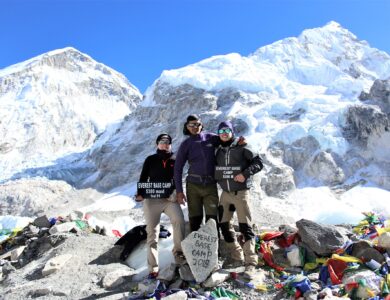
The Everest region, also known as the Khumbu region, is located in northeastern Nepal, inside the Solukhumbu district of Nepal. There are a total of five peaks that are above 8,000m altitude, including the highest peak in the world, Mt. Everest(8848.86m). Also Everest region has 12 officially designated trekking peaks that vary from 5,806 m to 6,476 m. The Everest region is controlled by the Sagarmatha National Park, which was established in 1976 to control its unique ecosystem, flora, and fauna.
What Makes the Everest Region So Special?
The Everest region is famous for its natural beauty as well as the human achievements made while climbing Mt. Everest. Let’s see the famous things in the Everest region that you can see and explore while you are here:
Mount Everest: Mount Everest, known as Sagarmatha in Nepali and Chomolungma in Tibetan, is the dream place for trekkers and climbers all over the world. It is the world’s highest place on earth, and reaching here is a life-changing experience.
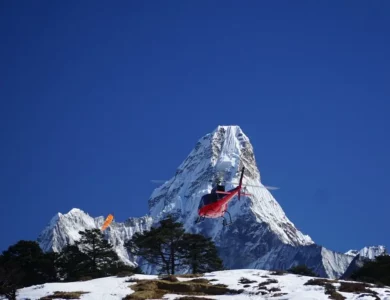
Other Majestic Peaks: Along with Mount Everest, other impressive mountains in the Everest region are Lhotse (8,516m), Makalu (8,485m), Cho Oyu (8,201m), and beautiful Ama Dablam (6,812m).
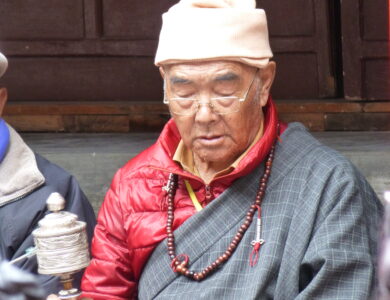
The Sherpa People: The home of the brave Sherpa people is the Everest Region. Their bravery for climbing and helping other climbers to reach the summit and for rescue is recognised throughout the world. You can learn Sherpa local culture, religion, and visit a sacred Buddhist monastery.
Sagarmatha National Park: Officially recognised as a UNESCO World Heritage Site in 1979, this national park is rich in diverse flora and fauna. People visit the Everest region to witness some of the world’s endangered species, like the snow leopard, red panda, Himalayan musk deer, and rare Himalayan birds.
World-Class Trekking: The world-famous Everest base camp trek lies in the Everest region. Apart from the iconic EBC trek, the other famous trek here includes:
- Everest Base Camp Trek
- Gokyo Lakes Trek
- Everest Three Passes Trek
- Gokyo–Chola Pass–EBC Trek
- Everest Helicopter tour
- Everest View Trek (Short Trek)
- Tengboche Monastery Trek
- Ama Dablam Base Camp Trek
- Renjo La Pass Trek
- Phaplu to Everest Base Camp Trek
- Everest Base Camp Trek via Salleri
Lukla/Tenzing Hillary Airport: The world’s most dangerous airport also lies in the Everest region. Locally named Lukla Airport, it is the main point of the Everest region. Its short runway and dramatic location, and thrilling landing make it one of the most unforgettable airports in the world.
Khumbu Icefall/Glacier: Another iconic feature of the Everest region is the Khumbu Icefall and the Khumbu glacier. Known for ice blocks, deep crevasses, and constantly moving glaciers, people will be amazed by the view during trekking and expeditions.
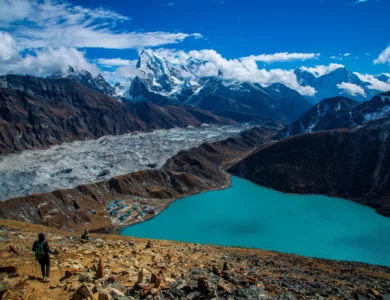
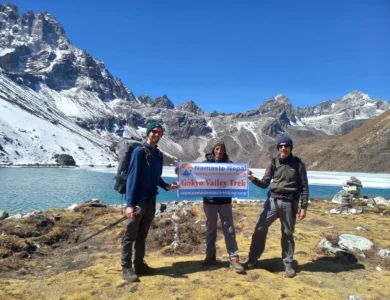
Gokyo Lake: Situated at an elevation of 4,700–5,000 m, Gokyo Lake is one of the world’s highest freshwater lakes. Gokyo Lake is named after the Gokyo Ri. Turquoise water and stunning mountain reflections on Gokyo Lake are beautiful things to see in the Everest region.
How to Reach the Everest Region
There are two ways to reach the Everest Region: by air and by land. Let’s see:
By Lukla Flight: The most suitable way to reach Lukla is by using the domestic flight. Travellers can get a direct flight to the Lukla airport from Tribhuvan International Airport(TIA) or from Ramechhap Manthali Airport. The flight duration will be around 30-35 minutes.
By road: There is no direct connection to Lukla, but the road construction is underway. People can reach up to Salleri/Phaplu or Thamdada by using 4*4 Jeeps, then start their trek in the Everest region.
For more details, check here: Lukla Flight
Permits Required To Enter the Everest Region.
Since the Everest region is a protective area to enter here, all tourists must pay a certain fee to enter. You can get the permit from a tour or trek agency or by yourself from Kathmandu at the Nepal Tourism Board office or directly at entry points like Monjo (Sagarmatha National Park entrance) or Lukla (Khumbu Pasang Lhamu Rural Municipality checkpost). The required permits are:
- Sagarmatha National Park Entry Permit: To enter the National Park.
- Khumbu Pasang Lhamu Rural Municipality Permit: To enter the Khumbu Region.
- Gaurishankar Conservation Area Permit: If you trek through Jiri.
Best Time To Visit For Your Annapurna Adventure
- Autumn (September to November): One of the best times to visit the Everest Region for trekking due to clear skies with moderate temperature conditions.
- Spring (March to May): Another best time to visit due to mild temperatures, longer days, and blooming seasons.
- Winter (December to February): Trekking is possible, but you need to face extreme cold and snowfall at high altitude.
- Monsoon: rainfall can make trekking difficult due to wet, slippery, and obstructed trails.
Internet and Communication in the Everest Region
Wifi: Wifi works well in the Everest region inside the tea house, but there is no wifi in the Everest base camp and higher altitude region. You need to pay a certain fee to use the Wifi to get connected.
Mobile Network: Local SIM ( Ncell or Ntc) works well in the lower region, but there is no connectivity in places like Gorak Shep, Everest Base Camp, and higher, remote areas.
Power sockets: Type C, Type D, and Type M power sockets are available in the tea house, but make sure to carry the power bank with you.
Banks And Atm Facilities
There are bank and ATM facilities in Lukla and Namche Bazar, but in other places, there are no facilities. Recently, new Atm facilities were added in Dingboche. But the service might not be reliable due to weather, power cuts, and network issues. So make sure to carry enough cash with you while travelling in the Everest region.
Food And Accommodation Facility in the Everest Region
The Everest region is one of the most developed trekking routes in Nepal compared to other trekking destinations. So the food and accommodation facilities are well-managed, comfortable, and widely available. You can find everything from simple to luxury accommodation in the lower region. But at the higher altitude, the facilities become limited. You can find food from veg-nonveg items, and you can even enjoy the luxury breakfast in the Everest View Hotel, which is located at 3,880 meters.
What to Pack for Your Everest Region Trip
The Himalayan weather conditions can be unpredictable, so it is necessary to pack the clothing and gear items that will cope with all weather conditions. Since you will be travelling to the Everest region by Lukla flight, make sure your luggage weight follows the airline rules. Let’s see the common things you need to pack while you are travelling in the Everest region:
Clothing
- Warm base layers (top and bottom)
- Fleece or insulated mid-layer
- Down jacket for cold mornings and nights
- Waterproof and windproof outer shell
- Lightweight trekking pants and shirts
- Thermal hat, gloves, and neck warmer
- Trekking socks (3–4 pairs)
- Comfortable, broken-in trekking boots
Gear & Equipment
- Daypack (30–40L)
- Sleeping bag suitable for high altitude
- Trekking poles
- Headlamp with extra batteries
- Sunglasses with UV protection
- Reusable water bottle or hydration system
- Water purification tablets/filters
Personal Items
- Basic first-aid kit
- Personal medications
- Toiletries and wet wipes
- Quick-dry towel
- Sunscreen and lip balm
- Power bank and charging cables
Other Useful Items
- Rain cover for your bag
- Snacks and energy bars
- Extra camera batteries
- Lightweight gloves and a sun hat
- Copy of important documents (passport, permits)
Everest Region Travel Guide: Safe and Responsible Tips
Hire Guide and Porter: To trek inside the Everest region, it is compulsory to hire a licensed trekking guide with you. Hiring porters is optional, but it will be comfortable if you hire a porter to accompany you. When you book the trek package, the cost of the guide and porter is often included in the package.
Travel Insurance: It is important to have travel and health insurance to travel in the Everest region to make your journey safe and comfortable. Also, during emergency situations helicopter rescue is required, so without insurance, the rescue cost can be high. So make sure to have an insurance policy that covers high-altitude trekking, medical evacuation, and helicopter rescue.
Acclimatize Slowly: The starting point of the Everest region, which is Lukla, its an altitude is 2,860 m. So when you take a direct flight from Kathmandu to Lukla, you will gain a rapid altitude. So, during the trek, follow the acclimatisation plan properly to avoid altitude sickness. If you catch any symptoms of altitude sickness, head to the lower region, and if symptoms worse, then ask for immediate rescue for the treatment.
Stay Hydrated: Many people don’t have a habit of drinking water while travelling. Due to dehydration, it can trigger altitude sickness, so make sure to drink enough water.
“Leave No Trace”: Every year, thousands of trekkers visit this Everest region to enjoy the natural beauty of this region. This region has a fragile environment and contains rare species of plants and animals. So it’s everyone’s responsibility to protect the Everest region by following the Leave No Trace policy during the trip.
Be Aware: There are no road transportation facilities in the village areas of the Everest region. Locals depend here on the yaks/donkeys/mules to carry the essential products from the city areas. So, during the trek, make sure to give the path to these animals if you ever encounter them on the journey.

