


 English
 Dutch
Dutch Japanese
 Hindi
Hindi Italian
 Spanish
 French
 German
 Chinese
 Korean
 Arabic
 Hebrew
 Russian
 Portuguese
 Danish
 Czech
Czech Polish
 Swedish
 Share
ShareAlps” vs. “Himalayas Trekking in Nepal “

 Updated: 2 December, 2025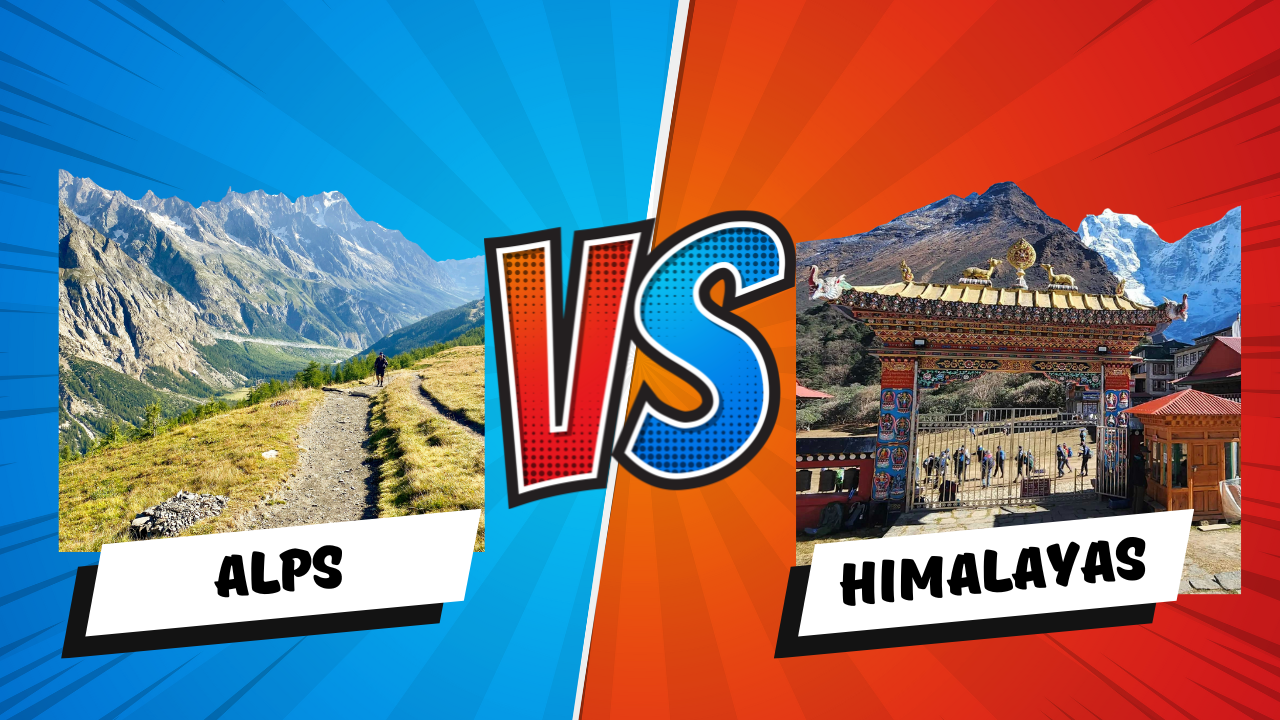
The call of the mountains is something we all feel. It is a natural urge to go close to high mountains, get a breath of fresh air, and challenge ourselves in nature. To most travelers, the first two things that come to mind whenever this feeling strikes them are the beautiful Alps in Europe and the mighty Himalayas in Nepal. Both of them are breathtaking adventures, beautiful sceneries, and life-changing moments. Yet every one of them offers quite a different experience.
It is not just a matter of picking a location on the map when deciding whether to go trekking in the Alps or take a Himalayas trip in Nepal. It is knowing what you desire, your hiking adventure, your funds, and the level of attachment to the mountains. This short guide will help you know the key differences in order to make the right choice of the destination for your new adventure in the mountains.
The Allure of the Alps: Seamless Adventure in Europe’s Backyard

The Alps provide the traditional and most beautiful mountain adventure in eight European countries. In the Alps, you have a convenient, secure, and highly varied trekking experience, with the snowy crags of the Swiss Alps to the sharp limestone cliffs of the Dolomites.
Geographical Tapestry & Accessibility
The Alps are a small mountain chain where numerous beautiful sceneries are located near one another. Green valleys, dense woods, blue lakes, cascades, vast glaciers, steep mountainous rocks, all this in a few miles.
The Alps are among the largest benefits because they can be accessed easily. International airports are found in major European cities such as Geneva, Zurich, Munich, and Milan. You can join their high-speed and efficient trains and buses and go directly to quaint alpine villages at the foot of well-known mountains.
This makes it very easy and pleasant to trek in the Alps. It is possible to frequently start a long trek immediately at the train station, forward your big bags to your next hotel, or even to do hard day hikes with the assistance of cable cars and mountain railroads.
Infrastructure & Support: A Trekkers’ Paradise
Perhaps the factor that makes Alpine trekking most distinct is the presence of well-developed infrastructure. It is not wilderness survival, but a highly-oiled machine that aims at helping hikers of every experience.
- Trails: The number of trails available in the Alps is vast, with each one being very well-maintained and clearly marked. Signposts are very common, precise, and more than that, most of them are colour coded or numbered, and therefore self self-guided trekking is a dream. Maps are superb, and GPS location is usually an added advantage and not a requirement.
- Accommodation: There is the hut system (Rifugios in Italy, Refuges in France, Hütte in German-speaking countries), which is a legend. These mountain lodges are equipped with dorm-like facilities, personal rooms in certain instances, tasty table food ( in most instances, multi-course), and invigorating beverages. Many also have hot showers. In addition to huts, there are beautiful guesthouses and hotels in the village, which are of various levels of comfort. Reservations, particularly huts in the season time, are strongly advisable.
- Logistics: The public transport penetrates far into most of the valleys, providing bail-out options or short-cuts. Access to an elevation is made available with the use of cable cars and chairlifts, which leave the trekkers with their own legs to do the most scenic parts or access heights that would otherwise be subjected to great ascents. Taking luggage between lodging is also not uncommon, especially in popular long-distance routes such as the Tour du Mont Blanc.
Cultural Immersion: Alpine Traditions & European Flavours
The cultural experience is rich and diverse in the Alps, whereas it is not as otherworldly as Nepal is. Every nation is flavoured in its own way:
- Swiss Alps: Accuracy, effectiveness, and breathtaking nature. Anticipate clean towns, local products of high quality, and a mixture of German, French, and Italian styles.
- French Alps: Gastronomy, pretty stone villages, and a more rugged and independent temperament in the high mountain regions.
- Italian Dolomites: An impressive mash-up of European efficiency and Italian style. Drama sceneries collide with the colorful hospitality, tasty pasta, and good local wines.
- Austrian Alps: Hearty food, traditional music, and a strong sense of local identity.
You will encounter domestic farmers tending to their farm animals, and cowbells will be heard echoing down the valleys. There are also old traditions that are practiced in everyday life.
The Alpine food is hot, hearty, and prepared predominantly using local products. The favorite food items are cheese fondue, rösti, schnitzel, pasta, and tasty local wine or beers.
Difficulty & Terrain: A Spectrum of Challenges
The Alps are friendly to everyone, including family members who want to take easy walks or challenging mountain climbers who are going through technical climbing.
- Easy to Moderate: Hundreds of low roads will wind across the mead and over lakes and through scenic villages. They are ideal for day hikes, family-based hikes, or those who want to have a more gentle introduction to mountain hiking.
- Challenging: Higher trails can be characterised by large height increases and decreases, bedrock, and even a little scrambling or attached cords (via ferratas, especially in the Dolomites). Glacial crossings are not prevalent in normal trekking paths but involve the use of guides and specialised equipment.
- Altitude: In the Alps, most trekkers will typically avoid altitudes over 3,000 meters (nearly 10,000 feet) and thus are far less prone to altitude sickness than in the Himalayas. The maximum altitudes of sleep, even during multi-day trips, are not usually more than 2,800 meters.
Best Treks & Seasons
- Iconic Treks:
- Tour du Mont Blanc (TMB): An iconic 170km route through Mont Blanc, across France, Italy, and Switzerland. Presents a wide range of views, well-furnished huts, and a good social ambience.
- Dolomites Alta Via 1 & 2: Multistage tours across the beautiful, exotic Dolomites of Italy with limestone spires. Alta Via 1 is easier, whereas Alta Via 2 is a difficult via ferrata.
- Walker’s Haute Route: A difficult walk between Chamonix, France, and Zermatt, Switzerland, through some of the highest mountains of the Alps (including the Matterhorn).
- Bernese Oberland: Switzerland has a region with iconic peaks such as the Eiger, Mönch, and Jungfrau, which has a plethora of shorter to multi-day walks.
- Season: The main trekking season will be late June to September, with July and August being the best. In early June, there is still a chance of substantial snow on the higher passes, and in the latter part of September, the air is cooler, and the number of visitors is smaller, but there is less daylight, and there is a possibility of early snow.
Cost Considerations: Quality Comes At a Price
The Alps are more likely to be quite costly to trek when compared to Nepal due to the increased cost of living in Western Europe.
- Flights: International flights to Europe.
- Accommodation: Mountain huts can range from €40-€70 per night for a dorm bed (often including half-board, i.e., dinner and breakfast). Hotels/guesthouses in villages start from €80-€150+ per night.
- Food: Meals in huts or restaurants are comparable to European city prices. Expect €15-€25 for a main course.
- Transport: Train and bus tickets, cable car fees can add up. However, regional passes can offer savings.
- Guides: While self-guiding is popular, hiring a UIAGM/IFMGA certified guide for more technical routes or safety costs €400-€700+ per day.
- Overall Budget: A moderate 7-day self-guided trek might cost €800-€1500 (excluding international flights), highly variable based on comfort and itinerary.
Who is Alpine Trekking For?
- Alpine trekking is best for those who are searching for a comfortable and well-supported trekking experience.
- Best for those who want to enjoy a solo trek with excellent navigation facilities
- Those who want to see diverse landscapes, enjoy good food, and visit charming villages.
- Those who are searching multi-day trek with lots of options for choosing difficulty level.
- Those who want to avoid altitude sickness or want to avoid reaching high altitudes.
- Those who want to enjoy trekking with limited time and want to trek without complex logistics.
The Majesty of the Himalayas (Nepal): An Expedition into the Roof of the World

Nepal is a landlocked country, located in the lap of the Himalayas, which gives an experience of trekking beyond just a physical activity. It is an exploration of a spiritual world, a cultural dive, and a challenge that defies the formidable odds of the world. In this case, the trekking usually seems to be more like an expedition.
Geographical Scale & Accessibility
Eight out of the fourteen 8,000-meter mountains in the world are found in the Nepali Himalayas, among them being Mount Everest. The size is enormous, and the scenery can be disheartening in scope. The scenery is a steep rise of the subtropical lowlands through terraced hillsides, rhododendron forests, deep gorges, and finally into the barren high-altitude alpine areas and glacial valleys.
Trailheads are generally more of a business than in the Alps. Kathmandu is the capital, and most of the international flights go there. There, domestic aircraft (e.g., to Lukla, in the Everest region, or Pokhara, in the Annapurna) or time-consuming and usually rough jeep or bus journeys are needed to get to the start point of a trek. Even the trip to the mountains is integrated into the adventure.
Infrastructure & Support: Rustic Charm & Local Hospitality
The Nepalese infrastructure is evolving at a very fast rate, but it still has a more rustic and adventurous aspect than the Alps.
- Trails: Trails are mostly well-worn and are along old trading routes between villages. Although high-profile trails such as the Everest Base Camp or the Annapurna Circuit are very noticeable, signs are either primitive or absent in more isolated places. The use of guides and porters is strongly suggested, and even necessary, to navigate, be safe, and have cultural understanding, particularly when walking outside the main trails.
- Accommodation: The Nepali trekking depends on the system of the teahouses. These are family lodges with a simple and, in many cases, very comfortable accommodation (a small room with two single beds, sometimes with an attached bathroom). Food is consumed in a common dining room, which in cold weather is usually heated using a wood-burning stove. Hot showers are not frequent, and electricity is solar-based, especially in high-altitude regions.
Cultural Immersion: Spirituality, Simplicity & Sherpa Heart
Nepal presents a rich cultural experience that has a strong connection to the trekking experience.
- Ethnic Diversity: Mountains are home to different ethnic groups. The Sherpa people, who are famous worldwide for their mountaineering skills and strength, stay inside the Everest region. You will also encounter people such as Gurungs, Tamangs, Rais, and many others during your visit. Each of them has its own unique dress, language, culture, and even food.
- Religion: Nepal is a sovereign nation with 81% of the people being Hindu. But if you go to a higher altitude, most of the people you will meet are Buddhist. You will see lots of stupas, monasteries, and mani walls, which give you a sense of spirituality and the peaceful teachings of Lord Buddha. Mountain people are very simple, and most of their daily work is based on agriculture and animal husbandry.
- Food: No matter which place you go for trekking in Nepal, your main course will be Dal Bhat. There is a popular saying, “Dal Bhat Power 24 Hour”. Other food items you can find here are momos (dumplings), thukpa (noodle soup), Momos (dumplings), fried noodles, fried rice, chapati with curry, pasta, macaroni, etc. The food will be simple, tasty, and made using fresh local ingredients.
Difficulty & Terrain: The Challenge of Altitude
The main challenge of the high altitude treks in Nepal is the demands of physical fitness and mental preparedness. Depending upon the nature of the trek you choose, you may face long walking days, steep climbs, cold temperatures, and changing weather conditions. It is mandatory to hire a licensed trekking guide here. Solo treks are banned due to safety reasons.
Let’s see some of the main challenges that you need to face while trekking in the Himalayas:
- High Altitude: Most classic treks ascend well above 3,500 meters (11,500 feet), with many routes reaching over 5,000 meters (16,400 feet) or even 5,500 meters (18,000 feet) at high passes or viewpoints.
- Altitude Sickness: Acute Mountain Sickness (AMS) is a real problem here. You need to have a well-acclimatisation plan and good knowledge of altitude sickness (AMS). If you neglect AMS, it can turn into HACE or HAPE, which can be life-threatening. You need to know when to turn down, because it is the only option once you catch AMS.
- Terrain: Trails range from established paths to rocky, uneven terrain, switchbacks, and sometimes sections with fixed ropes (e.g., on some passes of the Annapurna Circuit). Glacial moraines and snow crossings can be encountered at higher elevations, especially early or late in the season. Rivers are crossed via suspension bridges, some famously long and high.
- Physical Demands: For a multi-day trek, you need to be able to walk for around 6-7hours every day. The combination of hiking, rough terrain, and lower oxygen levels makes journeys physically exhausting.
Best Treks & Seasons
- Iconic Treks:
- Everest Base Camp (EBC): The world’s famous trek, EBC, takes you to the base camp of the world’s highest peak, Everest (8,848.86 m). It has everything—from Tenzing Hillary Airport, one of the world’s most dangerous airports, to Sherpa people, warm hospitality, monasteries, breathtaking mountain views, Buddhist monasteries, and more.
- Annapurna Circuit: Another popular trek in Nepal is the Annapurna Circuit, which takes around 14–18 days to complete and covers 160 to 230 km (100–145 miles). The trek passes through a diverse landscape, crossing Thorong La mountain Pass( 5,416m) and offers an incredible view of the surrounding peaks.
- Langtang Valley: A Short Langtang Valley trek located near Kathmandu, which lies inside the Langtang National Park, is popular for the beautiful Kyanjin Gompa, the Tamang culture, and breathtaking views from the vantage points Kyanjin Ri(4,773 m) and Tserko Ri(5,033 m).
- Manaslu Circuit: A restricted area for trekking, which you can trek only after having a special permit, takes you close to the eighth-highest peak, Manaslu, and the famous Larkya La mountain Pass (5,106m). The trails are peaceful and less crowded, offering a raw and authentic trekking experience.
- Season: The best trekking seasons in the Himalayas of Nepal are during autumn (September to November), offering clear skies, stable weather, and moderate temperatures, and spring (March to May), when rhododendrons bloom, though haze can sometimes obscure distant views. Winter (December-February) is cold but clear at lower altitudes; high passes can be snowbound. Monsoon (June-August) brings heavy rain, leeches, and obscured views.
Cost Considerations: Value for an Epic Journey
Flights from other countries to Nepal can be expensive; however, the expenditures on the trek are usually lower than in the Alps.
- Flights: International flights to Kathmandu. Internal flights (e.g., to Lukla for EBC) are an additional cost.
- Permits: Most trekking regions require permits (National park fees, local area permit, restricted area permits for some treks), typically ranging from $30-$100 USD per person depending on the area.
- Accommodation: Teahouses are very affordable, often $5-$10 USD per room per night. The expectation is that you will eat all your meals there.
- Food: Meals typically range from $5-$15 USD per dish, with prices increasing significantly with altitude due to porterage costs.
- Guides & Porters: Hiring a licensed guide (around $30-$50 USD per day) and/or a porter (around $20-$30 USD per day) is a significant but worthwhile expense for safety, navigation, and local support.
- Overall Budget: A moderate 12-18 day trek (like EBC or Annapurna Circuit) could cost $1,500-$3,000 USD (excluding international flights), again varying greatly based on services and comfort.
Who is Himalayan Trekking For?
- Those who want to experience the unique culture and want to experience spirituality during trekking.
- Those who want to experience village lifestyle and remoteness.
- Those who are in good health and have strong legs can walk continuously for 5-6 hours on average.
- Who loves simplicity and natural beauty over luxury.
- Anyone who wants to see the world’s highest altitude peaks above 8,000m
- Those who want to enjoy trekking with locals by hire guides and porters.
Direct Comparison: Alps vs. Nepal – The Nitty-Gritty
Let’s break down the key differences side-by-side to help clarify your choice:
| Feature | Trekking in the Alps | Trekking in Nepal (Himalayas) |
| Accessibility (Intl.) | Excellent, direct flights to major European cities, efficient onward transport. | Requires international flight to Kathmandu, often domestic flights/long drives to trailheads. |
| Infrastructure | Highly developed: extensive marked trails, sophisticated hut system, public transport, cable cars. | Developing: generally well-trodden trails, basic teahouses, less reliable transport. Guides/porters often essential. |
| Navigation | Easy for self-guided with excellent maps and signage. | Can be challenging without a guide/porter, especially off main routes. |
| Accommodation | Comfortable mountain huts (half-board), hotels/guesthouses in villages. | Basic teahouses (dorm/simple rooms, communal dining), rarely hot showers consistently. |
| Food & Drink | Diverse, hearty European cuisine, local specialties, wine/beer. | Simple, wholesome Nepali fare (Dal Bhat), momos, noodles. Tea is staple. |
| Cultural Immersion | Quaint European villages, diverse regional traditions, less ‘exotic’ but charming. | Deep immersion in Buddhist/Hindu culture, Sherpa hospitality, remote village life. |
| Altitude | Generally lower (max ~2800m sleeping, ~3500m passes), minimal AMS risk. | High altitude is central (3500m to 5500m+); AMS awareness and acclimatization critical. |
| Terrain | Varied: meadows, forests, glaciers, rocky peaks. Can include via ferratas. | Extreme: terraced fields, rhododendron forests, deep gorges, high passes, glacial moraines. |
| Difficulty | Wide spectrum from easy strolls to challenging multi-day treks. | Mostly moderate to strenuous, often compounded by altitude. |
| Cost (On-Ground) | Generally higher, reflecting European cost of living. | Generally lower, good value for the experience, but international flights can be pricier. |
| Support System | Self-guided common, rescue services efficient. | Guides/porters highly recommended for safety and local logistics. Rescue slower/costlier. |
| Best Seasons | Late June – September (July/August peak). | September – November (Autumn); March – May (Spring). |
| Permits/Regulations | Often none for standard treks, or small regional park fees. | TIMS card, National Park fees, sometimes restrictive area permits. |
| Wildlife | Chamois, Ibex, Marmots, eagles. | Yak, Himalayan Thar, elusive snow leopard, diverse birdlife. |
| Sense of Remoteness | Less remote, often near roads/villages, modern comforts accessible. | Greater sense of wilderness and remoteness, especially off main trails. |
Making Your Choice: Tailoring the Adventure to Your Soul
Ultimately, the “better” destination is entirely subjective and depends on what you seek from your trekking adventure.
Choose the Alps if:
- Comfort is a priority.
- You’re new to multi-day trekking.
- You prefer self-guided adventure.
- Time is limited, or you want a shorter trip.
- You want to combine trekking with other European travel.
- You’re concerned about high altitude sickness.
- You enjoy variety without extreme conditions.
Choose Nepal Himalayan trekking if:
- You want to have an epic, transformative journey.
- You want to experience a different lifestyle with ancient culture and traditions.
- Ready for wilderness with basic facilities of lodging and food.
- You love the rustic teahouse atmosphere and the difficulties of travelling to remote locations.
- You are physically fit and healthy for high-altitude treks.
- You want to trek in groups, with licence guides and hiring porters, and want to gain insight into the region.
- If you have a longer vacation for travel and trekking(at least a week).
Essential Considerations for Both Alps And Himalayan Treks
No matter if you choose the trek in the Alps or in the Himalayas of Nepal, here are some global things that you need to follow for your safety:
- Physical Preparation: No treks in the world are as easy as walking in the park. So maintain your body health and build endurance before heading for a trek.
- Appropriate Gear: Gears are there to protect you. So invest in high-quality trekking gear and carry all the necessary items like a first aid kit, personal medication, and toiletries.
- Insurance: If you travel without insurance and something happens during the trek, then it will cost you a lot. So always make sure to buy insurance that covers all the risks, including helicopter rescue.
- Respect Local Culture & Environment: Earth is our only home, so no matter where you make sure to clean and protect the natural beauty. Respect each other and respect other religions and cultures.
- Flexibility: The weather in the mountains is well-known for changing quickly. Be ready for modifications to your plans, delays that you didn’t expect, or having to rearrange your itinerary.
Conclusion: Two Worlds, One Mountain Spirit
The Alps and the Nepali Himalayas are like titans in the trekking world. Each one has its importance and gives you a unique trekking experience. Whether you want to enjoy your trek with a delicious meal in a modern alpine hut or enjoy the view of the world’s highest and beautiful mountain with a sip of Yak Butter tea, choosing them is actually up to you. Thanks for reading!!! Enjoy your trek!!!
If you are planning to trek in Nepal, Namaste Nepal runs various treks in Nepal. To know more in detail, make sure to contact us or email us.

Sabin Shrestha is an experienced content writer with over 4 years of expertise in creating clear and engaging content. He specializes in writing about lifestyle, travel, health, and technology, delivering well-researched articles that connect with readers. Known for his storytelling skills and attention to detail, Sabin creates content that informs, inspires, and leaves a lasting impression on audiences.

